There
are several descriptions and relics that testify to the importance of sound
in ancient ceremonies and structures but it is only now that we are
becoming aware of the extent that it was incorporated. Recent
investigations into Palaeolithic cave-art have revealed an
association between areas which produce a strong resonance and
the location of the art. This finding demonstrates that the properties of sound were
being recognised, explored, appreciated and recorded over 30,000
years ago.
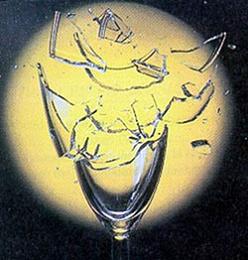
The power of sound has been demonstrated by opera
singers who have been known, on occasion, to shatter glass simply by
producing the correct sound. This effect was presumably already
understood when the story of the shattering of the 'walls of Jericho' as
written in the 'Old Testament':
... 'The captain of the Host of
the Lord came to Joshua before he stormed Jericho and told him to 'circle
the city for six days, and seven priests shall blow seven trumpets of rams
horns, and on the seventh day, when you hear the trumpets, all the people
shall shout with a great shout and the city shall fall down flat'...
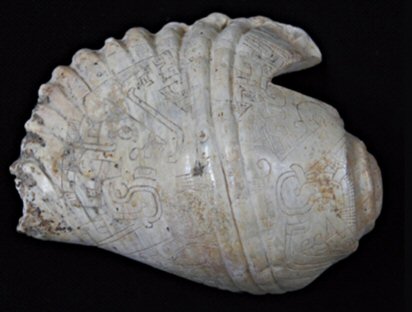
Archaeologists unearthed 20
complete Strombus galeatus marine shell trumpets in
2001 at Chav�n de Hu�ntar, an ancient ceremonial center in the
Andes. Polished, painted and etched with symbols, the shells had
well-formed mouthpieces and distinct V-shaped cuts.
If the shells were played
inside the stone chamber in which they were found, the drone
would have sounded like it was coming from several different
directions at once. In the dimly lit religious centre, it would
have created a sense of confusion.
Sonics are commonly associated in tradition
with the moving of heavy stones.
A story was told by the local Aymara Indians to a Spanish
traveller who visited
Tiahuanaco shortly after the conquest spoke of the
city's original foundation in the age of Chamac Pacha, or First
Creation, long before the coming of the Incas. Its earliest
inhabitants, they said, possessed supernatural powers, for which
they were able miraculously to lift stones of off the ground, which
"...were carried [from the mountain quarries] through the air to the sound
of a trumpet".
(1)
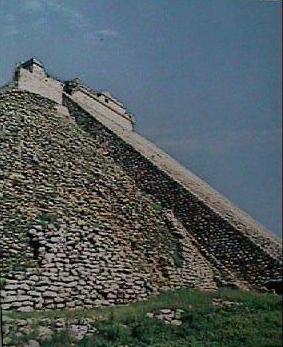
Mayan legends says that the temple of Uxmal (right), in
Mexico
was built by a race of dwarves, which apparently only had to whistle and 'heavy
rocks would move into place'. It is said that if a person stands at
the base of the pyramid-like Temple of the magician and claps their hands
the stone structure at the top produces a 'chirping sound'
(1)
According to classical Greek writers, Thebes, the
capital of Boeotia was founded by Cadmus, a celebrated Phoenician. It
was finished off, the story goes, by a son of Jupiter named Amphion, who
was able to move large stones to the sound of a lyre of harp, by which
manner, he was able to construct the walls of Thebes. Appollonius Rhodius,
who lived in the third century BC, poetically recalled in Argonautica
how Amphion would sing loud and clear on his golden lyre' as 'rock
twice as large followed his footsteps'. Tradition surrounding Cadmus
clearly indicate that Thebes was founded by Phoenician migrants who must
have settled there in the third or second millennium BC.
Phoenicia's oldest known historian, Sanchaniatho, spoke of
the god Ouranus or Coelus founding the first city at a place
called Byblos. He also said that one of the gods 'Taautus' (the
Egyptian Thoth), founded the Egyptian civilisation. He also states that
Ouranus 'devised Baetulia, contriving stones that moved as having life'
In the early 20th century, a Swedish doctor is reputed to
have witnessed stone blocks 1.5 metres in length and a metre in height and
width, being levitated through the air through the process of sound.
(1)
Examples of sympathetic vibrations in Prehistoric structures.
At least two structures at the Mayan ruins of
Chichen Itza in Mexico display unusual
and unexplained acoustical properties:
The Great Ball-court:
The Great Ball-court is 545
feet long and 225 feet wide overall. It has no vault, no continuity
between the walls and is totally open to the sky.
Each end has a raised "temple" area. A whisper from end
can be heard clearly at the other end 500 feet away and through the length
and breath of the court. The sound waves are unaffected by wind direction
or time of day/night. Archaeologists engaged in the reconstruction noted
that the sound transmission became stronger and clearer as they proceeded.
In 1931 Leopold Stokowski spent 4 days at the site to determine the
acoustic principals that could be applied to an open-air concert theatre
he was designing.
The Castillo:
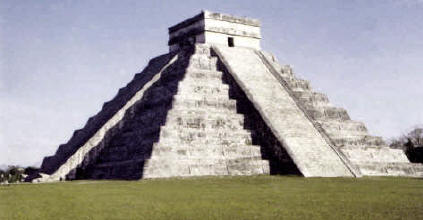
This structure is a temple
that looks like a pyramid and is the one most commonly pictured on travel
brochures for the Mexican Yucatan. Apparently if you stand facing the foot
of the temple and shout the echo comes back as a piercing shriek. Also, a
person standing on the top step can speak in a normal voice and be heard
by those at ground level for some distance. This quality is also shared by
another Mayan pyramid at Tikal.
If a person stands at the bottom of the Castillo
and shouts, the sound will echo as a shriek that comes from the top of
the structure. If someone stands on top and speaks in a normal voice,
they can be heard on the ground at a distance of 150 metres away.
(1)
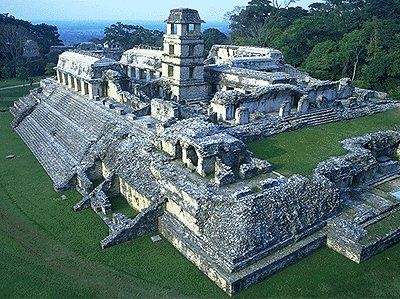
At
Palenque,
also in Mexico, it is apparently the case that if three
people stand on top of the three pyramids, a three-way conversation can
easily be held.
It is also said that if a person
stands at the base of the pyramid-like Temple of the Magician and claps
their hands the stone structure at the top produces a 'chirping sound'
(1)
The study of Palaeo-acoustics has revealed that
several ancient structures were built so as to incorporate acoustic
phenomena in their design. Examples such as the
Hypogeum in Malta, and the Mayan
Temples at Chitzen Itza
demonstrate that this science was well recognised and understood.
Remarkably, these same effects are now known to have been utilised at several
cave systems in Palaeolithic Europe.
We now know that sound was important, and probably considered magical and mysterious by, people at least
as far back as the Palaeolithic (Old Stone Age) painted caves of France
and Spain, dating to tens of thousands of years ago. It has been found
that some of the stalactites and stalagmites in them are musical, in
that they will issue pure bell-, drum- or gong-like notes when struck.
Some archaeologists refer to these musical calcite formations as �lithophones�. Most if not all of these relatively
rare features had been painted with geometric signs and animal figures
in Stone Age times, and they also display ancient percussion marks � so
ancient, in fact, that they are visible only through a covering of
calcite deposits.
Currently, Russian and Finnish
researchers are studying �palaeoacoustic� ringing rock sites on the
shores of Lake Onega in Russia. They have found that the sound these
natural stone �drums� make when struck is amplified by the surface of
the lake, causing it to carry for kilometres around. The features are
surrounded by concentrations of rock art. Similarly, archaeologists in
the United States have identified �ringing rocks� � boulders that emit
bell- or gong-like sounds when struck. Many of these, too, are marked
with rock carvings. (2)
Article: (July, 2008) National Geographic:
'Prehistoric peoples chose places of natural
resonant sound to draw their famed cave sketches, according to new
analyses of Palaeolithic caves in France. In at least ten locations,
drawings of horses, bison, and mammoths seem to match locations that
focus, amplify, and transform the sounds of human voices and musical
instruments. An intriguing suggestion is that the acoustic properties of
a cave partly influenced what animals were painted on its walls'.
(Link
to Article)
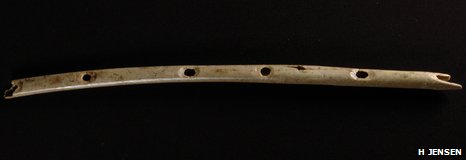
A bird-bone flute
unearthed in the Hohle Fels cave was carved some 35,000 years ago and is the
oldest handcrafted musical instrument yet discovered, archaeologists say
(2).
The
Hohle Fels flute is more complete and appears slightly
older than bone and ivory fragments from seven other
flutes recovered in southern German caves and documented
by Conard and his colleagues in recent years.
Another flute excavated in
Austria is believed to be 19,000 years old, and a group of 22 flutes found
in the French Pyrenees mountains has been dated at up to 30,000 years ago.
In addition, several prehistoric bone flutes have also been found in China.
Article:
(New Scientist, p. 14, November 28, 1992) - 'The Acoustics Of
Rock Art'
'"..S. Waller has visited rock art sites in Europe,
North America, and Australia. Standing well back from the painted
walls, he claps or creates percussion sounds, and records the echo's
bouncing back. It turns out, that rock art seems to be placed
intentionally where echo's are not only unusually loud but are also
related to the pictured subject matter. Where hoofed animals are
depicted, one easily evokes echo's of a running herd. If a person is
drawn, the echo's of voices seem to emanate from the picture itself!
"At open air sites
with paintings, Waller found that echo's reverberate on average at a
level 8 decibels above the level of the background. At sites without
art the average was 3 decibels. In deep caves such as Lascaux and
Font-de-Gaume in France, echo's in painted chambers produce sound
levels of between 23 and 31 decibels. Deep cave walls painted with
cats produce sounds from about 1 to 7 decibels. In contrast, surfaces
without paint are 'totally flat'."
Article:
(Nature, 338. (1989): 382. Chris Scarre) - 'Painting by
Resonance'
"...Did the painted
caves of western Europe once resound to the music of
Palaeolithic chants? Such is the thesis put forward by
Iegor Reznikoff and Michel Dauvois in the latest issue
of the Bulletin de Ia Societe Prehistonque Francaise
(85. 238-246; 1988). The authors have studied three
caves in the Ariege department at the foot of the French
Pyrenees. Their results suggest that the acoustics of
the caves played a significant part in determining where
the paintings were located, and this observation leads
directly to the supposition that music or chants were
important elements in cave ceremonies around 20,000
years ago.
Reznikoff and Dauvois
rely on the fact that in certain places ("points of
resonance") the caves resonate in response to particular
notes. They proceeded slowly through the cave using
their voices to produce a series of notes spanning
almost three octaves, from C to G3. They extended the
range of notes for a further two octaves by harmonics
and whistling. Where there was a resonance response,
they recorded the location and the particular note
eliciting the response. They used these observations to
draw up a resonance map of the cave.
The resonance of the
caves is not in itself surprising. but the significance
of the study becomes apparent when the authors compare
their points of resonance with the location of cave
paintings. They draw three main conclusions. First,
most of the cave paintings are at or within one metre of
points of resonant. The Grande Salle at Portel, for
example, which gave no resonance response, also has
relatively few paintings. Second, most of the points of
resonance correspond to locations with cave paintings.
Indeed, the best points of resonance are always marked
in this way. Finally, the authors claim that the
location of some of the paintings can be explained only
by the resonance of that particular location. A good
example is number 23 at Portel where a particularly
effective point of resonance is marked by red painted
dots, as there is not enough room for a full painted
figure.
Reznikoff and Dauvois
remark from their own experience on the impressive
effect of cave resonance, which would have been all the
more striking in the flickering half-light of the simple
lamps or tapers used by the original artists. Drums,
flutes and whistles may have been used in cave rituals -
bone flutes have been found at several Palaeolithic
sites in Europe of roughly the same age as the
paintings. The potential of cave resonance would,
however, be elicited only by the much greater range of
the human voice. The image of the cave artists chanting
incantations in front of their paintings may not be too
fanciful. Reconstructing prehistoric sounds is
inevitably a risky and ambitious venture, but this study
is of particular value in drawing new attention to the
likely importance of music and singing in the rituals of
our early ancestors.
The same resonance
effects as those found in Palaeolithic cave systems (above)
has also been noted in the underground chambers of the
Hypogeum on Malta.
The
Hypogeum, Malta:
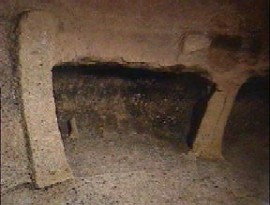
The
Hypogeum on Malta contains a 'speaking chamber' which is a hole in the
wall carved with a rounded interior surface. The result is that
anything spoken into it produces an echo which reverberates
throughout the hypogeum. It is speculated
that this hole was part of a ceremonial process.
Several small chambers (right) in the Hypogeum are also suspected of
being used for ritual purposes as from within these cubicles, echoes
from the 'speaking' chamber reverberate into a rhythm that is
similar to the human heartbeat.
'An effectively random selection of
megalithic chambered sites in England and Ireland were
tested for their natural (primary) resonant frequencies,
with only the great chambered passage-mound of Newgrange in
Ireland being pre-selected due to the need for special
permission. The findings surprised the ICRL researchers: all
the investigated chambers were found to have a natural
primary resonance frequency in the 95-120 Hertz band, with
most at 110-112 Hz � this despite variations in sizes and
shapes of the chambers. There was even evidence of
�retro-fitting�, as if internal features within the chambers
had been placed to �tune� the natural resonance to the
required frequency. The great chamber of Newgrange resonates
effectively at 110 Hz, and the 19m (62-foot) passage behaves
like a wind instrument, with sound waves generated within
the chamber filling it, their amplitude decreasing towards
the entrance'.
(2)
The 110 Hz frequency is in the baritone
range � the second lowest level of the male singing voice.
It is therefore possible to speculate that chanting male
voices could have been used in these supposed tombs for the
silent dead. Current experiments are showing that the
specific frequency range around 110 Hz tends to stimulate a
certain electrical brain rhythm associated with particular
trance-like states.
(For a detailed peer-reviewed paper on
this, see Time & Mind 1:1, March 2008)
New research suggests that the
ancient stone circles and burial mounds of north west Europe may have
been designed to act as giant loudspeakers to amplify drums being played
during rituals. Science correspondent David Whitehouse reports:
'Scattered across the landscape of north west Europe are prehistoric
monuments from the Neolithic era. Stone circles like Stonehenge as well
as covered burial chambers can be over 5,000 years old.
The stones stand silent in the landscape but a new study of these
ancient structures has found that they possess some remarkable
acoustical properties.
When Aaron Watson of Reading University visited a Neolithic stone
circle in Scotland he noticed a curious echo which changed as he moved
around inside the circle.
Tests with audio recording equipment showed that the large,
flat-sided stones were positioned in such a way to reflect sound towards
the centre of the stone circle.
But it is the Neolithic burial mounds that have the strangest
properties. They usually consist of a long chamber which is reached by
crawling through a small tunnel.
'I was amazed by these caverns,' said University of Reading physicist
Dr David Keating.
'The caverns vary in size but their resonant frequencies are very
similar. They would amplify a fast drumbeat producing enhanced sounds
and echoes during rituals, he added.
Dr Keating suggests that the caverns are designed to generate an
acoustic phenomenon called Helmholtz resonance - the hollow type of
sound created by blowing a stream of air across the top of an empty
bottle.
Calculations suggest that drumming at two beats a second would have
caused resonance. Inside the dark chamber with its stale air and
presence of the dead, the enhanced sound would have produced an
unforgettable experience for Neolithic man.
Modern experimentation has shown that sound can be
influential in the recovery of patients. Music has been shown to
beneficial to us even before we are born and ultrasound is
commonly used today to assist recovery of various ailments
including repairing broken bones.
(3) The traditional
resistance to 'alternative' healing methods is being challenged
by the results of experiments involving sound, and more
interestingly, research at several prominent prehistoric sites
appear to show that the connection between sound and healing
dates back into prehistory.
The Stonehenge Bluestones:
Following the 2008 Archaeological
dig at Stonehenge, Prof's. Darville and Wainright proposed that the
site was once considered the 'Neolithic Lourdes'.
(3)
In relation to this is one of the most intriguing aspects of
Stonehenge, which is the question of the importance of now famous
'Preseli Bluestones', which were transported over 140 miles to the
site from near Gors Fawr in Wales.
The longstanding debate over the reason why stone was chosen from
such a distance, when 'sarsen' stone was locally available, appears
to have been met with an answer in relation to this topic, as this
particular stone has a longstanding association with both healing
and sound. Bluestone - or a relatively high proportion of them
(perhaps as much as ten percent) have the usually rare property of
being �musical�. That is, they can ring like a bell or gong, or
resound like a drum, when struck with a small hammer-stone, instead
of the dull clunking sound rock-on-rock usually makes. That this
property has been noted locally down the generations is shown by the
�Maenclochog� (�Ringing stones�) village place-name in the Preseli
area'. (2)
When we add this information to that
provided by
Geoffrey of Monmouth, who made a note
in his history of Britain in 1215 AD that the 'Medicinal power of
the stones was stimulated by pouring water over them'.
(10).
We can be sure that the Bluestones
have had a longstanding tradition for being used for curative
purposes. It is noted that
the oldest human remains found by
Parker Pearson�s team date to around 3,030 B.C., at approximately
the same time as the arrival of the first bluestones (Stonehenge
II).
Article: Heritage Daily (Feb, 2012)
'Stonehenge Design Based on Auditory Illusion'.
(Quick-link)
Glass has a natural resonance
- a frequency at
which it will vibrate easily and at which body of the glass vibrates under
resonance. If the force making the glass vibrate is big enough, the
size of the vibration will become so large that the glass breaks.
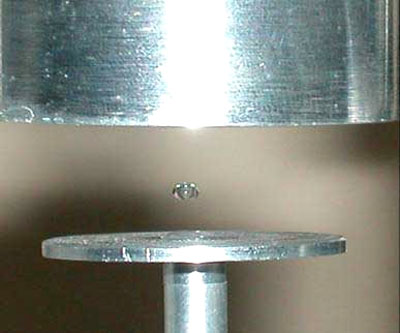
The Physics of Sound Levitation:
A basic acoustic levitator has two main parts:
A transducer,
which is a vibrating surface that makes sound, and a reflector.
Often, the transducer and reflector have concave surfaces to
help focus the sound. A sound wave travels away from the transducer
and bounces off the reflector. Three basic properties of this
travelling, reflecting wave help it to suspend objects in midair.
Article:
(2014) - Japanese scientists move objects using acoustic
levitation: (Quick-Link)
This is an acoustic levitation
chamber, designed and built in 1987 as a micro-gravity experiment
for NASA related subject matter.
Article: (New Scientist, July, 2011)
'Water Levitated by Tibetan Singing Bowls'....
'Tibetan singing bowls,
ancient instruments used for meditation, can be manipulated
to produce droplets that levitate, bounce and skip across
water.
The study began when a "sound healer" in Florida pointed out
the droplet phenomenon and sent a bowl to co-author John
Bush, a mathematician at the Massachusetts Institute of
Technology. "We were motivated by curiosity," Terwagne says.
Terwagne and Bush didn't
excite the bowls with a mallet, which produces rich sounds
comprising different frequencies. Instead, they used a
speaker to excite the bowl at particular frequencies. With a
high-speed camera, the researchers recorded the droplets'
ejection and behaviours. With the slowed-down footage, they
measured the locations and movements. The video shows
droplets levitating on the surface and the rim. The higher
frequency of the song, the smaller the resulting drops.
The bowls suggest new ways to create and
manipulate droplets that skitter across an air film atop a
surface.
Article: Scientists levitate
small live animals using sounds...
In the past, researchers at Northwestern Polytechnical
University in Xi'an, China, used
ultrasound fields to successfully levitate globs of the
heaviest solid and liquid�iridium and mercury, respectively.
The aim of their work is to learn how to manufacture
everything from pharmaceuticals to alloys without the aid of
containers. At times compounds are too corrosive for
containers to hold, or they react with containers in other
undesirable ways.
"An interesting question is, 'What will happen if a living
animal is put into the acoustic field?' Will it also be stably
levitated?" researcher Wenjun Xie, a materials physicist at
Northwestern Polytechnical University, told LiveScience.
Xie and his colleagues employed an ultrasound emitter and
reflector that generated a sound pressure field between them.
The emitter produced roughly 20-millimeter-wavelength sounds,
meaning it could in theory levitate objects half that
wavelength or less.
After the investigators got the ultrasound field going,
they used tweezers to carefully place animals between the
emitter and reflector. The scientists found they could
float ants, beetles, spiders, ladybirds, bees, tadpoles and fish up to a little more than
a third of an inch long in midair. When they levitated a fish and tadpole, the researchers added
water to the ultrasound field every minute via syringe.
The levitated ant tried crawling in the air and struggled
to escape by rapidly flexing its legs, although it generally
failed because its feet find little purchase in the air. The
ladybug tried flying away but also failed when the field was
too strong to break away from.
The research team reported their findings online Nov. 20 in
the journal Applied Physics Letters.
...A curious principle,
discovered by Christiaan H�ygens in the 1650s...
Huygens found that if you leave
two clocks with pendulums ticking in close proximity for long
enough, then they fall into perfect time, resulting in one hearing
a single clock ticking.
This is related to the low
frequency of 1 cycle per second ( 1Hz ) frequency being
experienced by both timepieces, and therefore being emitted, or
radiated. The noise made by a clock is essentially a form of
simple loudspeaker. The mass of it moves the air in such a way
that you can hear a click. Because you can hear a click, then the
same sound pressure is being applied to the case of the other
clock just the same.
Modern Myths of Acoustic
Levitation:
Tibetan Monks levitating stones: (Excerpt from
'Anti-gravity and the World Grid' edited by D.H. Childress):
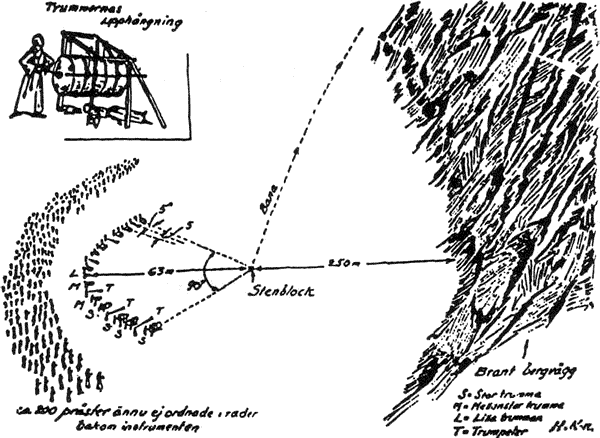
'A Swedish doctor, Dr. Jarl, a
friend of Kjelsons, studied at Oxford. During those times he
became friends with a young Tibetan student. A couple of years
later, it was 1939, Dr. Jarl made a journey to Egypt for the
English Scientific Society. There he was seen by a messenger of
his Tibetan friend, and urgently requested to come to Tibet to
treat a high Lama.
After Dr. Jarl got the leave he
followed the messenger and arrived after a long journey by plane
and Yak caravans, at the monastery, where the old Lama and his
friend who was now holding a high position were now living.
Dr. Jarl stayed there for some
time, and because of his friendship with the Tibetans he learned a
lot of things that other foreigners had no chance to hear about or
observe.
One day his friend took him to a
place in the neighbourhood of the monastery and showed him a
sloping meadow which was surrounded in the north west by high
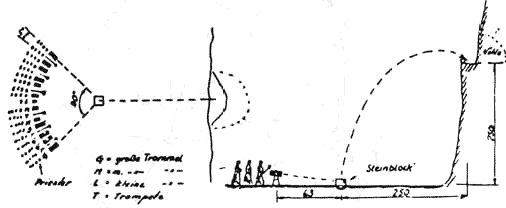
cliffs. In one of the rock walls, at a height of about 250 metres
was a big hole which looked like the entrance to a cave.
In front of this hole there was
a platform on which the monks were building a rock wall. The only
access to this platform was from the top of the cliff and the
monks lowered themselves down with the help of ropes.
In the middle of the meadow,
about 250 metres from the cliff, was a polished slab of rock with
a bowl like cavity in the centre. The bowl had a diameter of one
metre and a depth of 15 centimetres. A block of stone was
manoeuvred into this cavity by Yak oxen. The block was one metre
wide and one and one half metres long. Then 19 musical instruments
were set in an arc of 90 degrees at a distance of 63 metres from
the stone slab'.
'The radius of 63 metres was
measured out accurately. The musical instruments consisted of 13
drums and 6 trumpets (Ragdons) Eight drums had a cross-section of
one metre, and a length of one and one half metres. Four drums
were medium size with a cross-section of 0.7 metre and a length of
one metre. The only small drum had a cross-section of 0.2 metres
and a length of 0.3 metres. All the trumpets were the same size.
They had a length of 3.12 metres
and an opening of 0.3 metres. The big drums and all the trumpets
were fixed on mounts which could be adjusted with staffs in the
direction of the slab of stone. The big drums were made of 1mm
thick sheet iron, and had a weight of 150kg. They were built in
five sections. All the drums were open at one end, while the other
end had a bottom of metal, on which the monks beat with big
leather clubs. Behind each instrument was a row of monks.
When the stone was in position
the monk behind the small drum gave a signal to start the concert.
The small drum had a very sharp sound, and could be heard even
with the other instruments making a terrible din. All the monks
were singing and chanting a prayer, slowly increasing the tempo of
this unbelievable noise. During the first four minutes nothing
happened, then as the speed of the drumming, and the noise,
increased, the big stone block started to rock and sway, and
suddenly it took off into the air with an increasing speed in the
direction of the platform in front of the cave hole 250 metres
high. After three minutes of ascent it landed on the platform'.
Continuously they brought new
blocks to the meadow, and the monks using this method, transported
5 to 6 blocks per hour on a parabolic flight track approximately
500 metres long and 250 metres high. From time to time a stone
split, and the monks moved the split stones away.
'Dr. Jarl knew about the hurling
of the stones. Tibetan experts like Linaver, Spalding and Huc had
spoken about it, but they had never seen it. So Dr. Jarl was the
first foreigner who had the opportunity to see this remarkable
spectacle. Because he had the opinion in the beginning that he was
the victim of mass-psychosis he made two films of the incident.
The films showed exactly the same things that he had witnessed'.
And Finally... Vortex Ring Manipulation:
Vortex rings are created by blowing a ring out of the
blowhole or by flipping a dorsal fin fast enough to create a
water vortex. Dolphins have been observed creating and
playing with these
rings by moving them around sonically and ultrasonically.
They bounce the rings off walls; they elongate them with
their flippers into huge, long spirals. Often, they appear
to make the rings larger then swim
through them for amusement.

 Archaeo-acoustics: