|
 Sacred Geometry:
The cumulative effect of sacred
geometry is the connection between the microcosm and the macrocosm.
|
|
What is 'Sacred' Geometry' : |
The synchronicity of the universe is determined by certain
mathematical constants which express themselves in the form of
'patterns' and 'cycles' in nature.
The outcome of this process can be seen
throughout the natural world as the following examples
demonstrate:
 |
 |
 |
 |
|
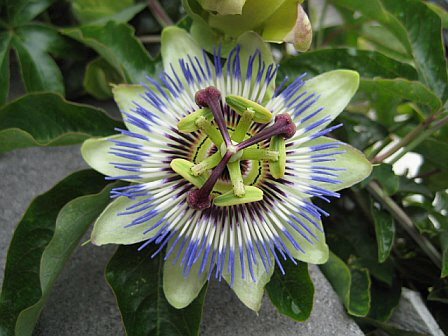
The Passion-flower |
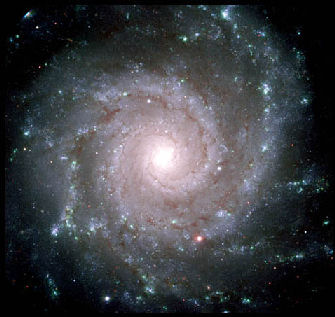
Spiral galaxy M74 |
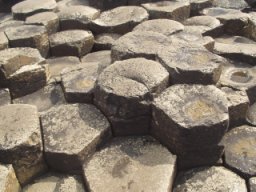
Giant's causeway, Ireland. |
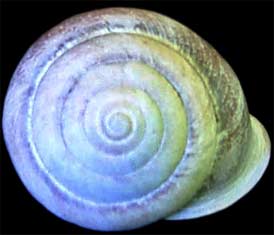
Spiral snail shells. |
These displays of mathematical and
geometric constants are confirmation that certain proportions are woven
into the very fabric of nature. Recognising the significance of this
simple fact offers us the means to understand how and why such matters
were considered sacred. They and everything around us, are the product
of the delicate balance between chaos and order.
The
word 'geometry' can be traced through its component parts:
The word 'Geo-metry'
comes from the Greek words Geos meaning 'Earth' and
Metron meaning 'To measure', which together literally
translate as the 'Measuring
of the earth' or 'Earthly measurements', an art which was traditionally restricted to the
priest-hood.
Sacred geometry has existed in many forms across the ages
It is often mistakenly said that geometry began with the Greeks, but before them were the Minoans,
the Egyptians, Sumerians, Indus valley, Chinese, Phoenicians and
of course, the builders of the western European megaliths all of
whom left clear geometric
fingerprints in their greatest constructions. The Greeks may well
have been the first to have offered geometry to the public at large,
but they were by no means the first to realise it.
Sacred-Geometry: The First Step.
One of
the most common shapes in nature is the circle, it is
therefore extremely significant to understand that all other geometric shapes can be determined from a
circle...with the use of only a compass (or string) and a ruler (straight
edge) as the following procedure illustrates...
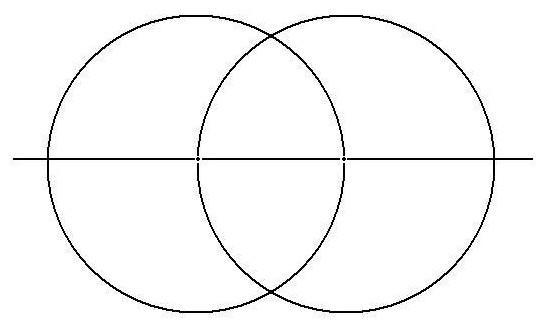
Starting with the Vesica-pisces...from which one is
able to produce...
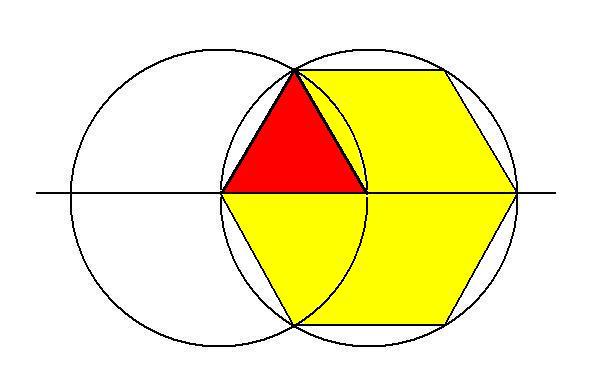
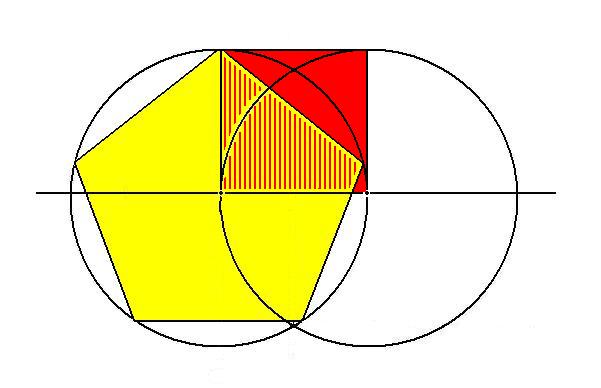
An Equilateral triangle, Hexagon, Pentagon, Square
and so on and so on..
The Vesica Pisces is one of the
key starting blocks from which sacred
geometry was applied to life.
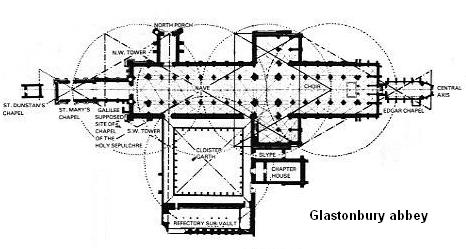
A continuation of the geometric Vesica Pisces results in the
geometric matrix named
Ad-triangulum...as used for the design of many of Europe's greatest
Cathedrals...
Featured Articles:
| |
|
 |
- The
Harmony of the Spheres.
The first confirmed
record of a knowledge of the relationship between
astronomy, music and geometry comes (almost
predictably) from the Greeks: in particular,
Pythagoras who wrote of the 'Harmony of the
Spheres', and of whom it was said: '...of all
men, he alone [Pythagoras] could hear the
music of the spheres...'
(The
Harmony of the Spheres) |
| |
|
| |
 |
|
|
|
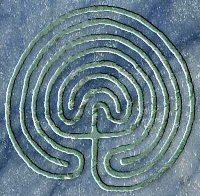
The
symbol for the Labyrinth has been found associated
with 'sacred' places for thousands of years from all
around the ancient world. More recently, more
especially from the middle ages onward, it has been
used as a tool for pilgrimage - representing our
metaphorical path through life.
(Labyrinths
Homepage) |
| |
|
| |
|
 |
|
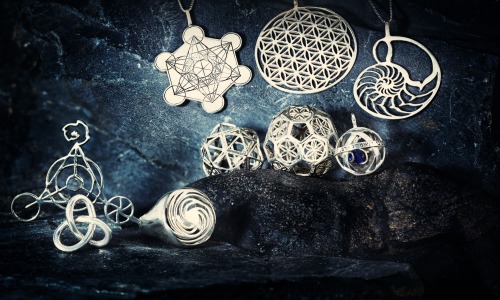
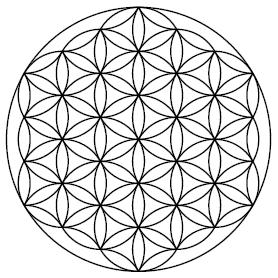
The flower of life symbol has
found its way into the human consciousness, it is no
more than an elaborate extension of the Vesica
pisces, but one within people have found themselves
lost in a state of perpetual imaginative bloom.
It is said to contain values that depict the
fundamental geometry of time and space.
(The
Flower of Life) |
| |
|
 |
|
|
-
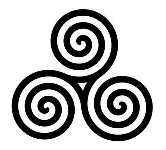
Spirals: Form and Function.
Spirals are one of the most a common forms of
natural geometry, being a product of the sacred
mean. They are associated with omphalos and
earth-navels and are regularly found engraved on
megaliths. Their original meaning is lost today
but spiral designs at such noticeable sites as
Newgrange and Chaco Canyon, has led many to
believe they were primarily astronomical.
(Spirals
Homepage) |
| |
|
| |
|
 |
- Geodesy
and the World Grid:
This section examines the theory
that geometry was applied in the placement of
certain prominent (sacred) prehistoric sites, based
on an understanding of longitude and latitude.
The 'linear-mentality' of our ancestors seems to
have had no frontiers, but what if any, was the
origin and purpose of networking sacred sites, and
how
(Geodesy
Homepage) |
| |
|
| |
 |
|
|
- Petrospheres
and the
Platonic Solids.
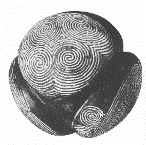
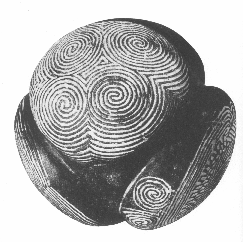
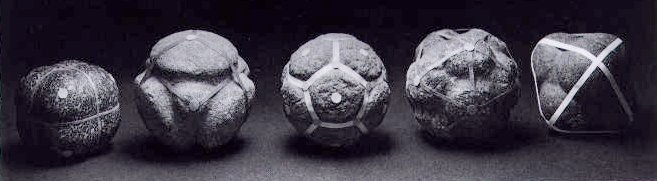
Of the hundreds of small
carved stone balls fond in Scotland, over 75%
have been found to conform to the five Platonic
solids. This remarkable discovery suggests an
association as yet undetermined. Although it is generally
believed that the Greeks discovered this
mathematical principle, these come from over
a thousand years earlier.
(Scottish
Petrospheres) |
| |
|
| |
|
 |
|
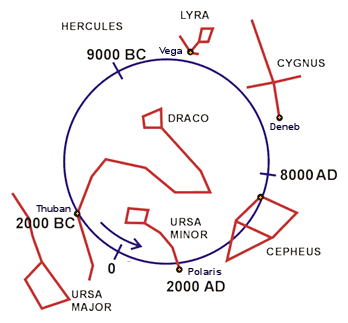
It has been proposed that the understanding of
sacred geometry extended into time and space, as
realised through the 'Platonic Year'.
Santillana
(6) and others
have shown that certain precessionary numbers were
encoded into ancient sacred buildings, texts and mythologies.
these same numbers appear to be reflected in
the natural geometry of the universe.
(The
Myth of Precession) |
| |
|
Other
Articles:
|
|
|
|
Sacred Geometry and the Great Pyramid of Giza:
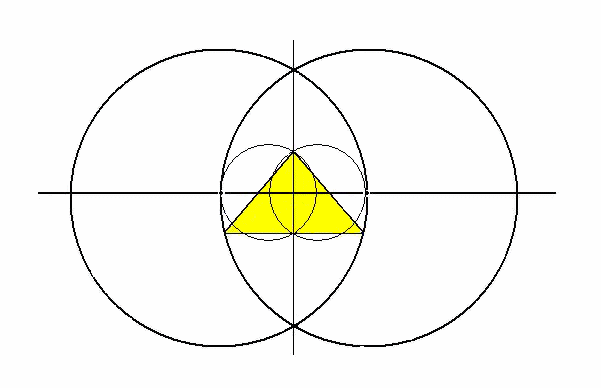
The exterior angle of the 'Great pyramid of Giza' can be
reproduced with the Vesica-pisces. It has been long suspected that the
Great pyramid was a subsidiary of geometric knowledge. There are several
other indications that sacred geometry was an important factor in the design of
the pyramid.
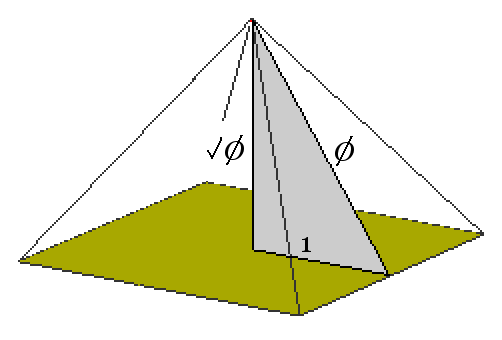
The Sacred mean (Phi), was also
recorded into the dimensions of the pyramid itself.
Pi and the Pyramid.
Egyptian mathematicians arrived at
a figure of 3.16 (as shown on the Rhind Papyrus), written 600 to 800
years later and far cruder than the precise ratio the great Pyramid
seems to express. The figure of Pi is recorded into the dimensions
of the Great Pyramid several times; As well as the
Height/Perimeter ratio of the pyramid itself
(2 ∏x
H = Perimeter)
The
perimeter of its main compartment, the so called �King�s Chamber,�
is also exactly 3.14 times its length, and the large granite coffer
or sarcophagus in this room shows the same proportion. In the
earlier, rhomboidal or �Bent Pyramid� at Dashur, a few miles to the
south, the sides begin to ascend at the same 2-Pi angle as
the Great Pyramid, then change half way up to 3-Pi (43 �� )
ratio.
(More on the
Geometry of the Great pyramid)
Pyramid Geometry and Latitude.
The exterior angle of the Great
pyramid is the exact same latitude that Silbury Hill was built, and at
the same time. It is perhaps no coincidence to find that exterior angle
of the Silbury monument has an exterior angle of 30 �,
the same as the latitude of Giza. This exact angle is also found
at nearby Stonehenge in the orientation of The Avenue,
which points towards the sunrise on the summer solstice. Stonehenge sits
exactly 1/4 of a degree of longitude south of Avebury.
This fact is
just one of many in the increasingly convincing argument in
favour of the existence of applied sacred geometry in
prehistory.
(British
Geodesy) (Egyptian
Geodesy)
(Geodesy
Homepage)
|
The Sacred mean - (5:8 or 1:1.618 or
Φ)
(The Divine Proportion, Golden Section, Golden ratio, Phi, )
One of the Key-stones of sacred geometry is the 'sacred mean' or
'golden section'.
|
The Mathematics of the Golden Ratio (Phi).
The golden section exists between measurable quantities of any kind where
the ratio between the smallest and the next size up is equal to the
ratio of the sum of the first two to the third.
Mathematically, the same proportion is generated with the following
formula:
√5+1 / 2
In numerical terms, the 'Golden ratio' was first popularised by
Leonardo Bigollo Fibonacci, the founder of the 'Fibonacci sequence',
a numerical series which simply follows the rule that the next number is
the sum of the previous two numbers.. as follows:
1, 1, 2, 3, 5, 8, 13, 21, 34, 55, 89, 144 etc...
|
Vitruvian Man: Leonardo Da Vinci.
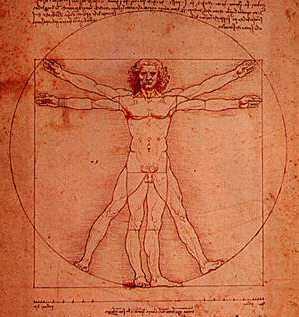 One of the fundamental
products of this underlying mathematical structure is the 'sacred
mean', a mathematical constant which is visible across the spectrum
of the natural world. The sacred mean is one of the
defining geometric qualities of life itself, as it plays an integral part of the
complex process of division and variation. Leonardo da Vinci illustrated
both the mathematical proportions of the human body, (which are
based on ratios of 1.618), and the concept of 'squaring the circle' with
his famous drawing (right). One of the fundamental
products of this underlying mathematical structure is the 'sacred
mean', a mathematical constant which is visible across the spectrum
of the natural world. The sacred mean is one of the
defining geometric qualities of life itself, as it plays an integral part of the
complex process of division and variation. Leonardo da Vinci illustrated
both the mathematical proportions of the human body, (which are
based on ratios of 1.618), and the concept of 'squaring the circle' with
his famous drawing (right).
Da Vinci was engrossed by Vitruvius, who had written that human
proportions should have a relationship in architecture. Vitruvius believed
that if human proportions could be incorporated into buildings they would
become perfect in their geometry.
One of Da Vinci's greatest discoveries was the division of the body into
proportions of whole numbers which he called 'cubits'. For example,
while the body is 4 cubits high, it can be seen on the same body that 1
cubit is both the length from shoulder to shoulder and from elbow to
fingertips.
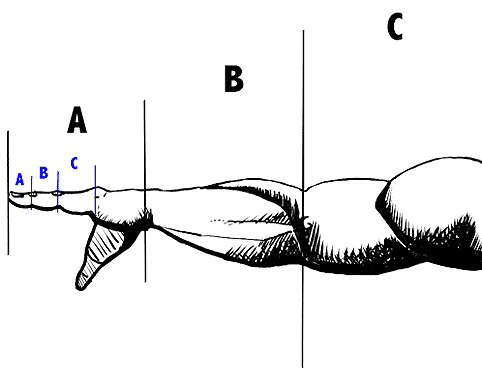
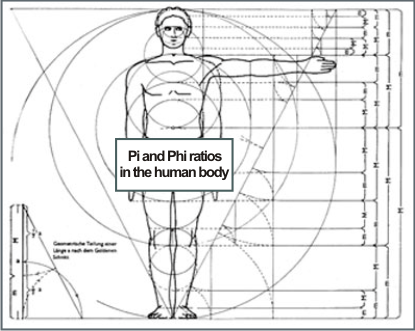
According to Vitruvius, the distance from fingertip to fingertip should be
the same as that from head to toe. The sacred mean can be seen in the ratios
of body parts. In the arm of the Vitruvian man for example, we can see that
the ratio of A is to B is the same as that of B to C. The same rules
apply throughout the human body.
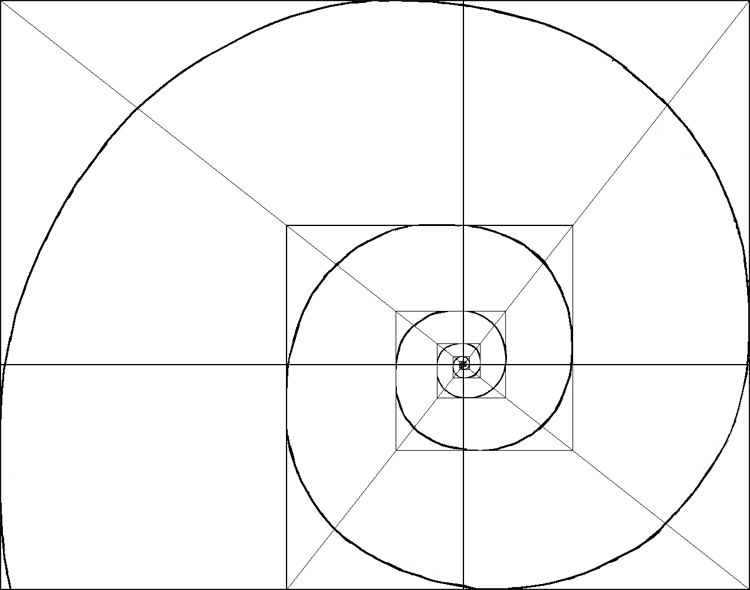
One of the mathematical products of the sacred mean is the spiral,
commonly found in nature.
(Spirals Homepage)
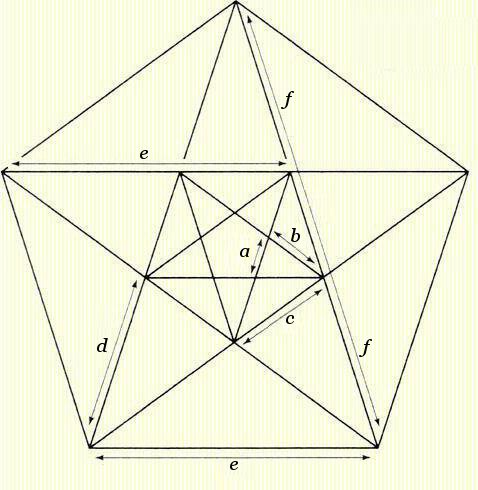
The sacred mean is also found in the geometry
of the pentagram and its associated
pentagon, where the ratio between the sides of the pentagon and its
extension into the pentagram also demonstrate a ratio of 1:1.618. In the
above diagram, Phi is found in the ratios of
a:b, b:c, c:d, d:e
and
e:f.
The
Flower of Life symbol
is considered to be sacred among many cultures around the world,
it is considered by some to be an 'Akashic Record'.
The Flower of Life
is the modern name given to a geometrical figure composed of
multiple evenly-spaced, overlapping circles. They are arranged to
form a flower-like pattern with a six-fold symmetry, similar to a
hexagon. The centre of each circle is on the circumference of six
surrounding circles of the same diameter.
The earliest
confirmed example of the pattern can be seen in the Assyrian rooms
of the Louvre museum in Paris. The design forms part of a gypsum or
alabaster threshold step measuring 2.07 x 1.26 meters (6.8 x 4.1
feet) that originally existed in one of the palaces of King
Ashurbanipal, and has been dated to c. 645 BC.
(7)
The Osireion,
Abydoss:
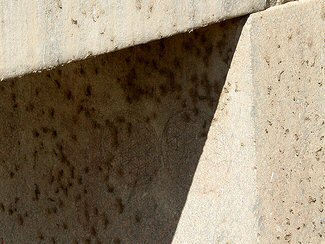
There are five possible
'Flower of Life' patterns on one of the granite columns and a further
five on a column opposite of the Osireion. Some are very faint and
hard to distinguish. They have not been carved into the granite but
been drawn in red ochre with careful precision.
Recent research
suggests that these symbols can be no earlier than 535 B.C., and most
probably date to the 2nd and 4th century AD, based on photographic
evidence of Greek text, still to be fully deciphered, seen alongside
the Flower of Life circles and the position of the circles close to
the top of columns, which are over 4 metres in height. This suggests
the Osireion was half filled with sand prior to the circles being
drawn which was therefore likely to have been well after the end of the
Ptolemaic dynasty.
(More
about Abydoss and the Osireion)
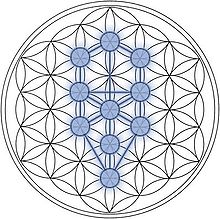
The Hebrew 'Tree of
Life'.
The Tree of Life is
most widely recognized as a concept within the Kabbalah, which is used
to understand the nature of God and the manner in which he created the
world. The Kabbalists developed this concept into a full model of
reality, using the tree to depict a "map" of creation. The tree of
life has been called the "cosmology" of the Kabbalah.
The Flower of life
and the Platonic Solids.
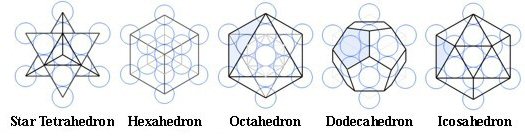
The
'Platonic Solids' are the names given to the five �perfect
shapes� formed when dividing a sphere into three-dimensional
forms, with each division having the exact same shape and
angle.
The Greeks
taught that these five solids were the core patterns of physical
creation. Four of the solids were seen as the archetypal
patterns behind the four elements (earth, air, fire, and water),
while the fifth was held to be the pattern behind the life force
itself, the Greeks' ether. These shapes predominated in the
hundreds of carved prehistoric petrospheres found in Scotland
with over 75% representing one of the Platonic Solids.
They came from a time over a thousand years earlier than the
Greeks. These same shapes are now realised to be intimately
related to the arrangements of protons and neutrons in the
elements of the periodic table.
(5)
(More
About the Scottish Petrospheres)
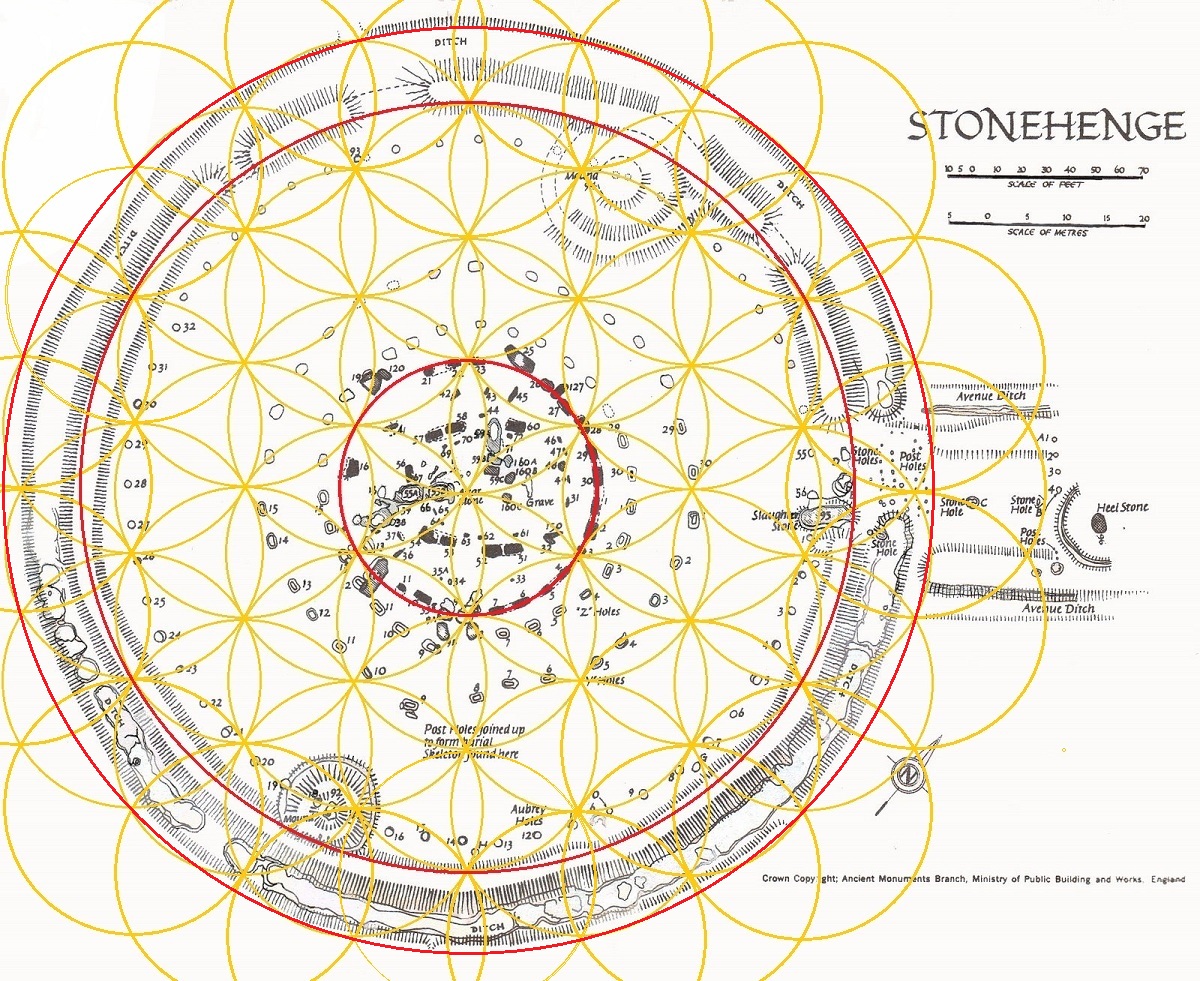
Stonehenge and The Flower
of Life.
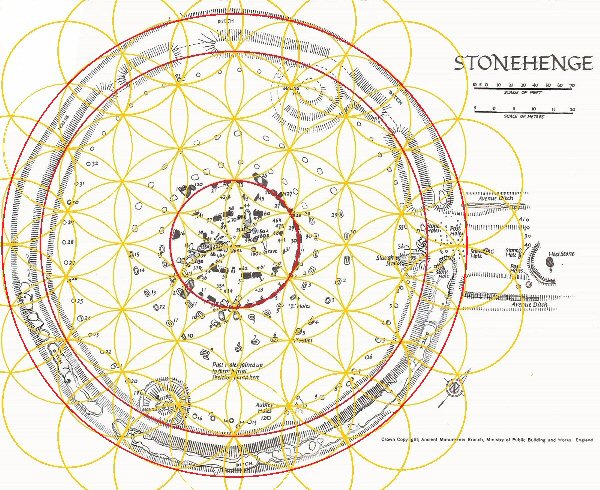
The geometry of
the 'Flower of Life' was recognised in the dimensions of Stonehenge.
Image Credits: Andrew Monkman.
(The World Grid: The invisible Made Visible)
(The
Geometry of Stonehenge)
|
Celestial Geometry - Sacred Astronomy: |

The mathematical harmony of
the universe is visible in the proportions of the planets of our own solar
system as the
following examples illustrate:
The diameter of the sun (864,000 miles) is the same as the perimeter of the
square of the moon
(4).
Sacred Venus : 'The Synodic
Cycle'
The ratio of the 'Sacred mean' can also be seen in the
rotations of Venus and the Earth around the sun so that for each five years that Earth rotates around the Sun,
Venus manages to rotate it eight times).
Venus orbits the Sun in 224.701 Earth days (
~.615 Earth years ), moving slightly faster than Earth. Because
of the two different orbital rates of Venus and Earth, Venus
must orbit the sun 2.6 times while Earth orbits 1.6 times before
the two planets align. This period (583.92 Earth days) is called
the Earth-Venus synodic cycle (synod means "place of
meeting").
(3)
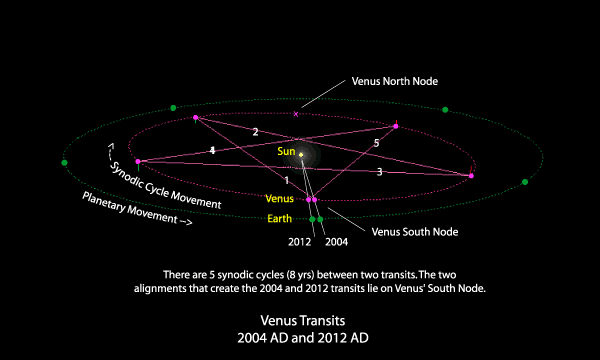
The result of this motion is that Venus
'draws' a pentagon around the
sun every eight years.
Bode�s law: Shows the simple mathematical relationship for the distances of the planets from the
our sun.
|
Planet
|
Formula
|
Distance from Sun
(Millions of Km�s) |
|
|
|
Bodes prediction |
Actual |
|
Mercury
|
0 + 4 / 10 = 0.4
|
60
|
58
|
|
Venus
|
3 + 4 / 10 = 0.7
|
105
|
108
|
|
Earth
|
6 + 4 / 10 = Au
|
150
|
150
|
|
Mars
|
12 + 4 /
10 = 1.6
|
240
|
228
|
|
(Asteroid belt)
|
24 + 4 /
10 = 2.8
|
420
|
550 wide
|
|
Jupiter
|
48 + 4 /
10 = 5.2
|
780
|
779
|
|
Saturn
|
96 + 4 /
10 = 10
|
1500
|
1427
|
|
Uranus
|
192 + 4 / 10 =
19.6
|
2940
|
2869
|
|
Neptune
|
384 + 4 / 10 =
38.8
|
5820
|
4496
|
|
Pluto
|
768 + 4 / 10 =
77.2
|
11580
|
5899
|
|
|
|
|
|
In addition to
which...
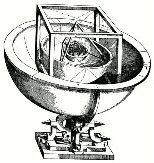
Keplers 3rd Harmonic law
� Kepler initially used the geometry of the Platonic solids to calculate the
distances of the planets from the sun. In doing so, he attempted to revive
the ancient tradition of Sacred Geometry with astronomy. Although this met
with reasonable success, proving the ancient systems to be accurate, he
eventually determined that the period of a planet or comets orbit is relate to its
distance from the sun in the following simple mathematical equation:
(p� = a�)
( Where p
= period of revolution and a
= the distance from sun in astronomical units �Au�).
Kepler furthered the research of Aristotle who first realised
the concept of the Harmony of the Spheres in which the planets positions and
'noise' were predicted according to musical harmonic ratios.
(Archaeoastronomy)
Sacred Geometry and the Harmony of the
Spheres.
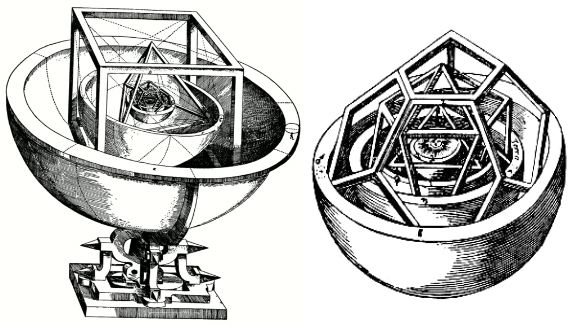
The theory of the 'Harmony of the Spheres' was originally proposed by
Plato, in which he envisioned the five 'perfect' solids to be enclosed
within imaginary spheres, each placed within the other. He proposed that
the distances of the planets from the sun showed similar ratios from
each other as the spheres surrounding each solids did. Modern science
has indeed shown that planets have unique 'vibrations', or 'sounds'
supporting Plato's conjecture.
(More
about the Harmony of the Spheres)
|
Sacred Geometry in Architecture: |
What Happens when geometric constants are placed into the
dimensions of buildings.?
S ome of the best examples of the application of sacred
geometry can be seen in constructions from the ancient world. It has
been shown (1), that ancient sacred and ceremonial sites were invariably built with
dimensions that incorporate mathematical figures such as infinite
numbers, astronomical or mathematical constants (such as Pi
or the 'sacred' mean), and the use of geometry (3:4:5 Pythagorean
triangle etc). The application of 'sacred' geometry in our most
important buildings is a reflection of the importance attached
to it, but exactly how early was such information realised?
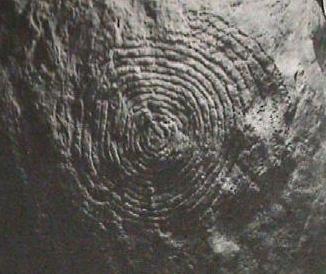
Following
his renowned survey of over 600 English stone circles, Prof. Alexander
Thom concluded that geometry had been used in their design.
Thom
also proposed that common mathematical units of measurement (the
megalithic yard), had been used in order to achieve these geometric
results. Surprising as this might sound, one finds that as well as working
with common units of measurement, the Neolithic people were also
apparently aware of geometric constants as the
following examples demonstrate.
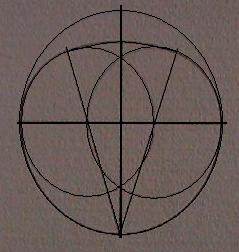
The geometric design above was
discovered by Prof A. Thom to have been used as a ground-plan for many
European 'Type I' and 'Type II' flattened stone circles
(Such as at Avebury, England).
(Note: Both type I and II circles
show the application of the Vesica-Pisces and 3:4:5 triangles)
Sacred geometry, involving both
astronomy and geometry appears to have been applied to prehistoric
quadrangles. It has been shown by Thom etc, that the Quadrangles at both
Stonehenge and Carnac have incorporated into them geometric constants
which relate to the latitude upon which they were built.
(More
about Quadrangles)
The Golden section is a ratio which has been used in sophisticated
artwork and in sacred architecture from the period of ancient Egypt
(1).
Freemasonry and Sacred Geometry.
Following the
collapse of the Roman empire, architects versed in geometry grouped
together into 'guild's', thus forming the roots of 'freemasonry'. The
tradition of building sacred/holy structures with applied sacred (euclidian),
geometry was continued into the middle ages by the 'Templars', who
envisioned their (mostly round) churches as 'microcosms of the world'
(1).
This idea was soon adopted by the Christian church, who began to employ
'sacred' dimensions into their religious buildings. These traditions were
carried in the form of 'freemasonry' until, as Pennick aptly quotes - 'The
lodges of freemasons closed down one by one. The last to go was the
premiere lodge of Europe - Strasbourg, which shut shop in 1777. From then
on, the arts and mysteries of freemasonry were carried on exclusively by
'Speculative masons' (1).
(Chartres
Cathedral and Harmonic Ratios)
A continuation of the geometric Vesica Pisces results in the
geometric matrix named
Ad-triangulum...as used for the design of many of Europe's greatest
Cathedrals...
We may never know for sure whether such geometry was
identified first from the observation of natural formations, or whether it came as a result
of an intellectual quest, but whichever, it is clear that these natural mathematical
building blocks began to be used in the design of many important man-made
structures.
(Labyrinths)
( Archaeoastronomy)
(Harmony
of the Spheres)
(Science
and Technology Homepage)
|
|