|
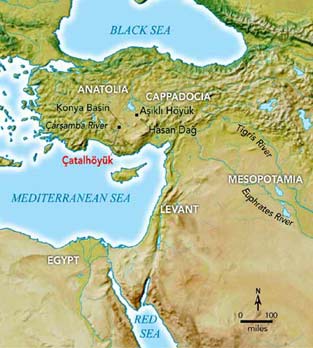
Location: Near Askaray,
Southern Turkey. |
Grid Reference:
38.349�
N. 34.23� E. |
 Asikli H�y�k:
(Fortress City).
Asikli H�y�k:
(Fortress City).
 Asikli
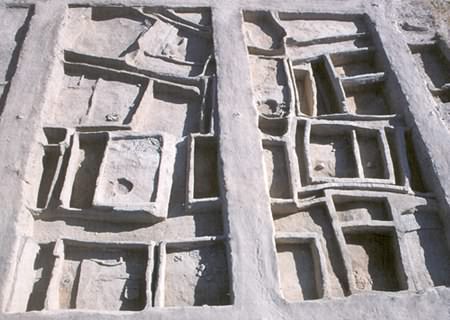
H�y�k began at around. 8,000 BC. As in Catal
H�y�k, the houses were mud brick and entered through the roof.
Archaeologists have discovered large numbers of artefacts made from
obsidian � black volcanic glass � as well as bone, antler and copper,
with an array of blade types. Here too the dead were buried beneath the
floor, and one of the skeletons that has been analysed shows evidence of
trepanation (the drilling of a hole in the skull), perhaps for some form
of surgery. Asikli
H�y�k began at around. 8,000 BC. As in Catal
H�y�k, the houses were mud brick and entered through the roof.
Archaeologists have discovered large numbers of artefacts made from
obsidian � black volcanic glass � as well as bone, antler and copper,
with an array of blade types. Here too the dead were buried beneath the
floor, and one of the skeletons that has been analysed shows evidence of
trepanation (the drilling of a hole in the skull), perhaps for some form
of surgery.
This was a sophisticated society with a wide-ranging
diet that consisted of meat from both wild and domesticated animals and a
variety of cultivated wheat, barley, peas and lentils � a huge step
forward in human progression from the nomadic hunter-gatherers.
(Click here for
Location of
site)
The discovery of the agate bead necklace (below-right), dated at 7,500 - 7,000 BC
demonstrates the level of specialisation attained at
this site. Discoveries such as these along with other early discoveries
from the middle-east are combining to overcome the prejudices of early
archaeologists, who placed such finds as these into the category of
'Anomalous artefacts'. Today,
with numerous other contemporary finds from the Anatolian highlands and
across the middle-east, a contextual platform is slowly forming upon which
to place such objects.
Polished Agate Bead Necklace (7,500 BC).
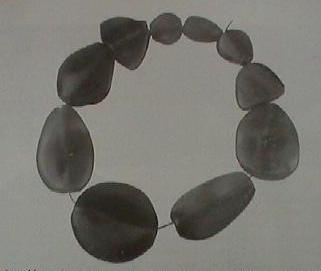 This
remarkable necklace was uncovered in 1989. It is made of burgundy agate and
consists of ten polished beads all shaped between 2.5 cm and 5.5 cm in
length and perforated longitudinally no more than 7-8 mm diameter, even
though agate is 7 on the Mohs' scale of hardness. This
remarkable necklace was uncovered in 1989. It is made of burgundy agate and
consists of ten polished beads all shaped between 2.5 cm and 5.5 cm in
length and perforated longitudinally no more than 7-8 mm diameter, even
though agate is 7 on the Mohs' scale of hardness.
(The necklace is dated to between 7,500 BC and 7,000 BC.
To drill similar holes today requires the use of a highly specialised
diamond-tipped tungsten-carbide drill.(1)
Regardless
of the technical difficulties of perforating the stones, the presence of
such early technology, expertise and craftsmanship does
not appear overnight but is developed over many years, suggesting an even
earlier origin to develop the required skills.
Polished
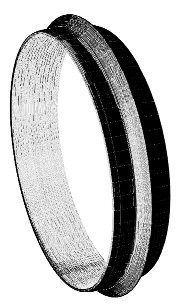
Obsidian Bracelet (7,500 BC):
 Article: HeritageDaily.com (Jan, 2012):
(Link
to Full Article)
Article: HeritageDaily.com (Jan, 2012):
(Link
to Full Article)
'Oldest
Obsidian Bracelet Reveals Amazing Craftsman's Skills in the
Eighth Millennium BC'.
'Researchers
have recently analysed the oldest obsidian bracelet ever
identified, discovered in the 1990's. Dated to 7,500 BC, the
obsidian bracelet is unique. It is not only the earliest evidence of
obsidian working, but it has a complex shape and a remarkable
central annular ridge, is 10cm in diameter and 3.3cm wide.
The research
has revealed that the bracelet was made using highly specialised
manufacturing techniques. The analysis carried out showed that
the bracelet was almost perfectly regular. The symmetry of the
central annular ridge is extremely precise, to the nearest
degree and nearest hundred micrometers. The surface of the
bracelet (which is very regular, resembling a mirror), required
the use of complex polishing techniques capable of obtaining a
nanometer-scale surface quality worthy of today's telescope
lenses'. (3)
The bracelet
is the first object to have been studied among some sixty other
polished obsidian artefacts.
No where
else in Anatolia can the unique obsidian tools be found like those from
Cappadocian Tumulus. Figurines, made from lightly baked clay, were unearthed
together with flat stone axes wrought in many fine shapes, chisels and
coulters made from bones and ornaments made from copper, agate and other
different kinds of stones. Evidence provided by a skeleton found here
indicates that the earliest brain surgery (trepanation) known in the world
was performed on a woman 20-25 years of age at Asikli Hoyuk.
(2)
In eastern Anatolia (Turkey), the main bead-producing centre during
the early Neolithic period
was at
�ay�n�.
(1)
Chronology:
The first settlement at Asikili began around 8,000
BC. (Ref: http://en.wikipedia.org/wiki/Asilikhoyuk)
|