Extreme Masonry:
(Extreme
Feats of
Masonry
from Around the Ancient World).
The myth of a primitive society of megalithic builders is being gradually
dispelled by discoveries from various disciplines. Apart from the
self-imposed extremes associated with transporting
and fitting stones weighing several hundred tons each in place, the
megaliths, pyramids and other prehistoric structures are examples of a human
relationship with stone and offer a glimpse into the mind of the builders,
through which we can see a common human potential to conceive, engineer, and
create the most
unique, and majestic
structures possible several thousand years in the past.
One of the most noticeably impressive factors
about the megaliths is their sheer size, which has given certain sites an almost
'mythological' status, with local traditions often claiming that they
were fashioned by 'giants' or 'gods', For example:
'A story was told by the local Aymara indians to a Spanish
traveller who visited Tiahuanaco shortly after the conquest, of the
city's original foundation in the age of Chamac Pacha, or First Creation,
long before the coming of the Incas. Its earliest inhabitants, they
said, possessed supernatural powers, for which they were able
miraculously to lift stones of off the ground, which "...were carried
[from the mountain quarries] through the air to the sound of a trumpet'.
'Numerous tales describe megaliths and single
large erratics as stones which giants had thrown or lost, while
megaliths in particular are also described as their graves, or
houses, or ovens (e.g. Temme 1840: 213; Bartsch 1879: 26�39;
Haas 1925: 53�60). The association of giants with megaliths goes
back to at least the 13th century, when the oldest references to
'tumuli gigantis' are found in written documents. Interestingly,
such stories replaced almost completely for several centuries
the references to ancient mounds as graves of earlier people
(e.g. 'antiquorum sepulcra', 'tumuli paganorum') which were more
frequent in the earlier sources (Lisch 1937: 11�15; Sippel 1980;
Th�te 1993: chapter 5.1). Today in Mecklenburg-Vorpommern,
megaliths are still generally known as H�nengr�ber
(giants' graves), for example in Forst Everstorf (Lisch 1837:
72)'.
(13)
Using large stones is one thing, but when
on comes across
examples of stones being moved weighing hundreds of tonnes when smaller stones would have been far
more ergonomically efficient
(such as the three 'foundation' stones at Baalbek), it becomes clear that the size of the stone
itself
was a consideration in the process of construction. The use of enormous
stones such as those seen at
Baalbek, Giza,
Stonehenge,
Carnac,
Jerusalem etc etc, reveal a level of
organisation and skill that has (naturally) reduced people to debate in the past.
Large Scale Megaliths:
Ba'albek:
One of the largest carved stones ever, weighing over 1000 tons, was left
unfinished by the constructors in the quarry. The technical abilities of the
builders of the Ba'albek platform are equally matched by their engineering
confidence which required them next to manoeuvre the stones
uphill
and fit them seamlessly into place. The associated difficulties of such a
labour provide an insight into the builders confidence, conviction and
ability.
The use of large stones is repeated
again and again all over the ancient world, leading one to ask: Why
?
The most common suggestion is that
larger stones provide structures with increased stability and
durability, which of course is true, but the excessive size of some stones when balanced
against the additional time, effort and manpower suggest that other
factors may have been involved.
The movement of the larger
megaliths are evidence of a 'social enterprise', involving the
co-operative skills and labour of large numbers of well organised
people. Alexander Thom suggested that the Neolithic people had a
society with hierarchy, structure and specialised 'castes'. This
idea starts to explains the means whereby such stones may have been
transported, but not why...
Mendelssohn
(11)
suggested that the purpose of building fantastically large
structures (such as the early-dynastic pyramids of Egypt) was simply to
unite the people through a common purpose, at the same time as
reinforcing the social hierarchy of 'Kingship'. Extending this
theory, one could say that if the size of the monument reflects the
greatness of the builder, then the size (and type) of stone in turn, reflects
the greatness of the masons.
The confidence of the megalithic builders
worldwide to work with such unnecessarily large stones is surpassed only by
their determination to transport specifically selected stones over vast distances to
previously selected sites.
Long-distance Megaliths: 'Pieces of Places'.
There are some extraordinary
accounts of unfeasibly large stones being moved over unnecessarily
long distances, suggesting that either the location or the stone
itself were
considered to have special properties.
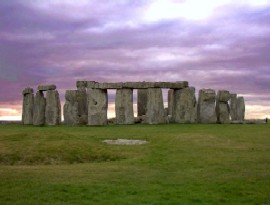
Stonehenge: Over 80 Bluestones
moved over 250 miles from Preseli, Wales.
Giza: 50+ ton Granite stones transported over
300 miles from Aswan.
Carnac: 300+ ton
Lochmariaquer menhirs transported over 25 miles.
Ollantaytambo:
50+ ton Porphyry stones transported 7-miles over 6000m high mountains and valleys.
: 90ft� sheets of Mica transported over controversial
distance of 2000 Km
But what does this
tell us, any more than that they wanted stone from one place to be
taken to another ?
In each case there must have been a large and
available work-force including skilled and un-skilled labourers,
support, organisers, all presumably under the
authority of an individual or caste. Such structures can be deemed as
'social constructions', and lend weight to Mendelssohn's theory of
large monuments/stones as symbols of 'greatness'. Assuming one of
the prerequisites of construction being the use of large stones, w
hy
then select to move such large blocks of stone over such long
distances when other more local and readily available sources were
known - as was the case at Stonehenge ?
Although it is
arguably obvious that the granite used in
the Egyptian pyramids was structural,
the same cannot be said of all sites, noticeably the 90�ft Mica sheets at
Teotihuac�n which were found sandwiched between stone layers of
stone and which served no apparent structural or aesthetic function.
Stones transported over long distances to build megaliths have
been described as 'pieces of places' (10)
The logistic difficulties involved with
long-distance transportation suggests that the stone itself was
considered to have qualities worth transporting it over such
extreme
distances. However, the very fact that stones were
transported so far also suggests that the new location itself must
have been of
equal importance to the builders.
At Vale de Rodruigo, in southern
Portugal, geological analysis were
carried out at the stones used in four megalithic graves. The
results were surprising as the stones had been brought to the site
from different locations of up to 10km distance. Geological research
suggests that this choice was probably predominantly motivated by
functional and practical reasons. As different rocks had different
appearances and physical characteristics it is suggested that they
were chosen according to a pre-conceived design. In addition, the
locations of the sites of origin of the different material
represents main celestial directions from the megaliths. This makes
it likely that the monuments also represent certain symbolic values
associated with the landscape and certain cosmologies.
(10)
The transportation of specific
stone over long distances suggests one of two things (or both):
The type/location of stone was more important than the extra labour incurred transporting it.
The location of the
monument was more important than extra work required to move
the stone.
It is interesting to note that one of common
factors of these 'long-haul' megaliths is that they were
invariably composed of granite (quartzite), which was the leading
choice of stone around the prehistoric world, noticeably in areas
such as Neolithic Europe, Early-dynastic Egypt and Pre-Columbian
America. This prejudice to quarry, cut and haul one of the hardest family
of rocks, in cases over hundreds of miles whilst ignoring more
locally available sources is a clear suggestion that the
qualities of the granite itself were important to the
megalithic builders.
Apart from being a particularly hard stone,
granite has several other physical properties which may have been
recognised by the ancient masons:
Firstly, a
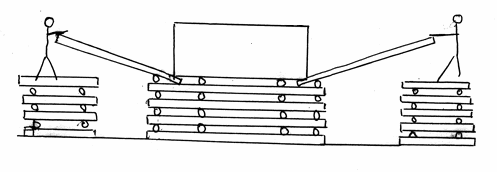
description of the act of raising a large stone, which is a comparatively easy task. In the picture
below, a crib of logs is progressively inserted under the
stone as it is raised by levers on either side. When the levers have
reached a height that causes difficulty for the operators, provide
the operators with a platform on which to work that rises as the
stone rises. This method has been tried and tested by archaeologists
with success.
The method for raising a large
stone.
Having decided upon
which stone to work with, it next fell upon the prehistoric masons
to move the stone from the quarry to its final resting place. While we
know already that stones as heavy as 1000 tons were being moved in
prehistory, these are the more exceptional cases. There are
however, numerous cases of stones exceeding 100 tones from all
around the ancient world and there are several descriptions and images to show
us how such stones were moved.
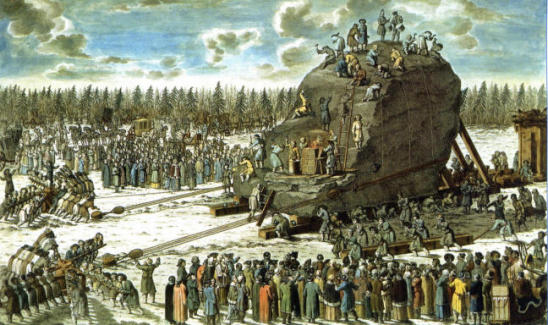
The largest
stone ever (recently) recorded to have been moved purely by human power
alone is the famous 'Thunder Stone' from Russia, which was moved
to St. Petersburg from the gulf of Finland. It was rolled along
on small balls placed on a track (Only 100m in length) at a rate
of 150m per day.
The
transportation of the 1500 ton 'Thunder-stone' in 1770
proves that human manpower alone can be employed to move
such heavy objects.
In Egypt, the
moving of large stones has a tradition dating back to the early
dynasties. The heaviest known blocks to be brought from Aswan to
Giza were the massive granite stones used for the roof of the King's
Chamber in the pyramid of Kufu. Each weighed between 50 and 70 tons
and several 5th and 6th Dynasty pyramids included gabled roofs with
blocks weighing up to 90 tons. There are also examples at Giza (see below) of limestone
blocks weighing as much as 200 and 400 tons. In the 18th Dynasty,
two colossal statues of Amenhotep III (the "Colossi of Memnon"),
each weighing more than 700 tons, were moved an overland distance of
700 km. Fragments of statues in the Ramesseum (built under Ramesses
II) suggest an original weight of around 1,000 tons.
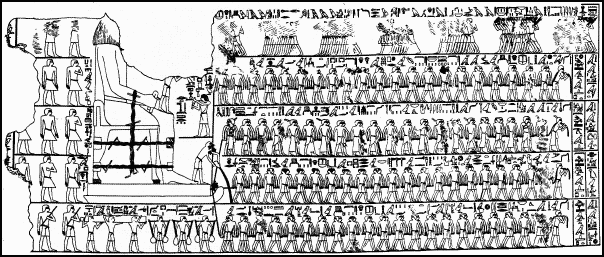
Moving a statue in 12th Dynasty Egypt.
Moving large stones over land
is a far more involved procedure than on water. Sledges were
available in pharaohic times, and workers were in great supply.
Friction was the main obstacle. Modern engineers working under primitive
conditions have found that, while moving blocks weighing up to 6-tons on a
sledge, friction could be reduced to nearly zero by wetting the
track with a lubricant (in this case, water). In the relief pictured
above, from the tomb of Djehutihotep, a man can be seen on the
leading end of the sledge pouring a liquid on the ground in front of
it. (12)
It has been estimated that a ratio of two men per ton would be
required for moving loads over flat surfaces; nine men per ton would
be required for moving loads up a 9� slope. Practical experiments
moving loads on a sledge over a lubricated track have shown that one
man could pull one ton (or an oxen, five tons).
(12)
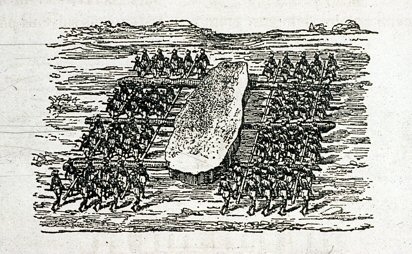
An
ancient method for moving heavy weights has been revived and
demonstrated in the field by Prof. J. Cunningham of Skidmore
College, USA. Following a system which relies on little more than
long, flexible poles of wood, we are shown how it is possible to
move otherwise apparently impossibly sized stones.
Ref: "Techniques of
pyramid-building in Egypt" Nature Vol 332 March 1988.
Pole systems such
as the one on the right (From India) illustrate the simple method
whereby enough manpower can be employed to move large stones.
Modern-day Experiments to Move
large Stones.
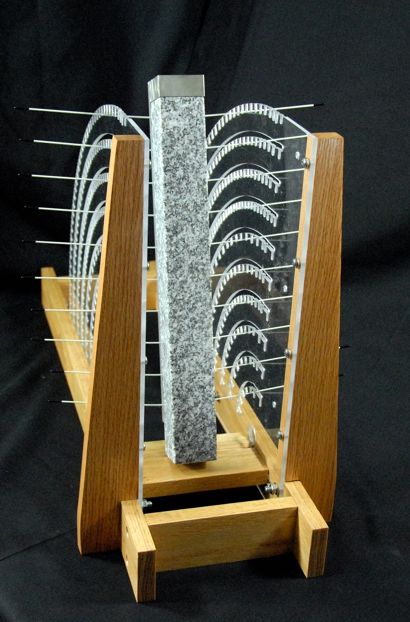
In the demonstrative
model above, Prof. Cunningham's theoretical work on moving large
objects shows that in theory, at least, using his pole system, a
single person should be capable of moving incredibly heavy stones.
Prof. Cunningham has
designed a means of elevating an obelisk using the same process of
flexible poles.
It is not surprising that the occasional eyebrow is raised
when we are confidently informed that
the Egyptian pyramids, the last remaining 'Seven Wonders' of the ancient
world, were constructed by people from the 'Neolithic' period. Apart
from the fact that eight largest Early dynastic 'Memphite' pyramids are
believed to have all been constructed in under 60 years
(11), we
are faced with numerous traces of applied mathematics, science and
technology within structures that have no apparent precedent in pre-dynastic
Egyptian culture.
The Giza Plateau.
Numerous impressive facts are regularly quoted concerning the astonishing
engineering challenges involved in the construction of t
he
'Great pyramid' of Giza, in Egypt, such as the estimated 2 million blocks
with an average weight of 2.5 tonnes which were used to build this pyramid
alone. However, there are several other masonry feats at Giza that are
equally astonishing.
It is often forgotten that before the pyramids
were built, the limestone plateau beneath was levelled to
an 'optical level of accuracy'
(8),
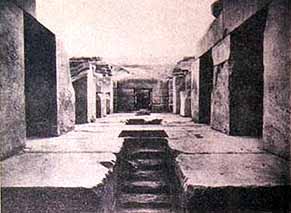
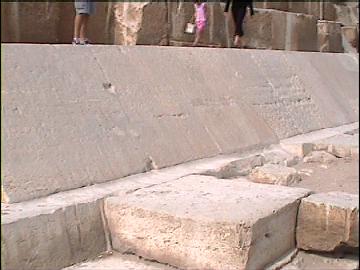
over which was placed a platform of carefully cut limestone
paving-slabs which
can still be seen to protrude from underneath the pyramids base
(Photo, left).
This platform is around 0.5m thick and despite the passing of time
and several earthquakes, remains level to within 0.8 of an inch
(21mm) over a distance of over 13 acres
(5).
The whole complex was carefully orientated to the cardinal directions.
The deviation of the Great Pyramid from true North is: 2′ 28", South �
1′ 58", East � 5′ 30" and West � 2′ 30".
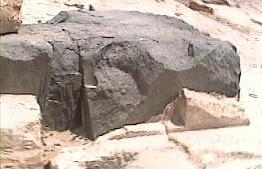
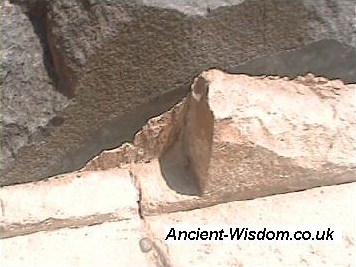
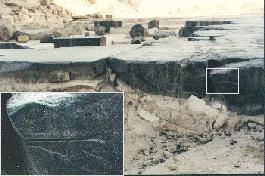
The seamless joins between the
basalt and the limestone pavements.
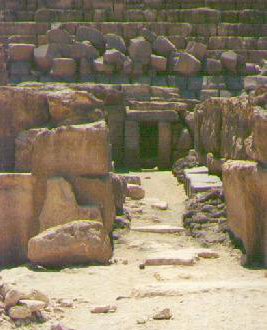
There are several extraordinary sized stones recorded at the Ghiza plateau,
with the largest regularly estimated at over 400 tons....
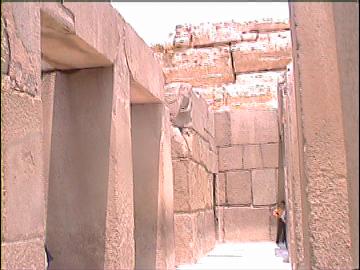
The largest stone at Giza is estimated to weigh
as much as 468 tons (5), and can be seen in the wall of the temple
east of the second pyramid (Khafre's). Other limestone blocks
weighing 200 tons can be seen in the wall of the Valley temple,
next to the Sphinx.
Temple East of 'Khafres' Pyramid.
'Largest stone
estimated 468 ton block'
(11).
(J. Cook; The Pyramids of Giza; p. 22). - 'Khafre
foundation stones > 400 tons'.
'Reisner
estimated that some of the blocks of local stone in the walls of the
mortuary temple weighed as much as 220 tons, while the heaviest granite
ashlars imported from Aswan weighed more than 30 tons'.
The
'Valley
Temple'
-
The Valley temple was built from huge granite blocks in the style of the Osireion at Abydoss.
They are estimated at around 50 tons + each. The whole temple in turn was encased in
even larger limestone blocks, the largest of which has been (enthusiastically) estimated at
around 200 tons.
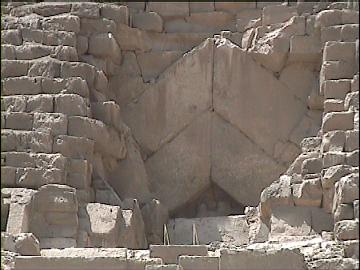
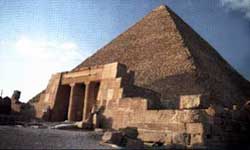
The 'Great' pyramid of Khufu - The 'Kings chamber' in the Great
pyramid is covered over with several granite stones estimated at 50-70 tons
each. The Gable stones over the entrance (left) and several of the stones covering
the descending passage are also several cubic metres in size.
As well as claims
of whole blocks being composed of concrete, Flinders Petrie noted
that:
The whole of the Great pyramid was originally
covered with a coat of polished limestone blocks. The faces of
these blocks have butting surfaces cut to within 1/100 of an inch
of mathematical perfection. Petrie said this of it:
...'
the
mean variation of the cutting of the stone from a straight line
and from a true square is but 0.1 inch in a length of 75 inches
up the face, an amount of accuracy equal to the most modern
opticians' straight edges of such a length. These joints, with
an area of some 35 square feet each, were not only worked as
finely as this, but were cemented throughout. Though the stones
were brought as close as 1/500 of an inch, or, in fact, into
contact, and the mean opening of the join was 1/50 of an inch,
yet the builders managed to fill the joint with cement, despite
the great area of it, and the weight of the stone to be moved-
some 16 tons. To merely place such stones in exact contact at
the sides would be careful work, but to do so with cement in the
joints seems almost impossible'.
(7)
The builders of
the Giza pyramids managed to cut granite stones with
almost perfect precision to fit side by side with their neighbours (i.e. the
Kings chamber). With
each stone being of a unique size, it was a remarkable achievement to say
the least. It is currently believed that the stones were prepared at ground
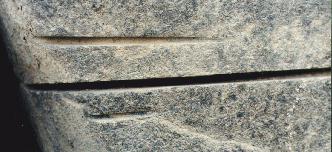
level, then lifted into position. Fortunately for us, the masons left their
marks on some of the stones as the following i mages from Giza demonstrate:
Although no large contemporary tools have been found at Giza, the 'saw'
marks above, along with others on the 'King's coffer' leave us with the
clear conclusion that the early-dynastic Egyptians were using tools tipped
with precious or semi-precious stones. This idea is borne out by numerous
discoveries of partially finished stone vases which have been
'core-drilled', also requiring the use of blades tipped with a harder stone.
The
use of core-drilling can be seen on the largest blocks of
stone such as the 'king's coffer' in the 'Great' pyramid at Giza, as
first noted by Petrie, down to the smallest ornamental trinkets
(right), and the apparently 'mass-produced' stone vases, frequently
carved from hard stones such as granite and obsidian.
The early-dynastic
masons were so accomplished at their art that there have been several
claims that not only were they 'machining' stone with the use of
the lathe and specialised drilling equipment, but that they also had
'high-speed' and 'high-pressure' tools.
The Enigma of Puma-Punka,
Bolivia: 'Door of the Puma'
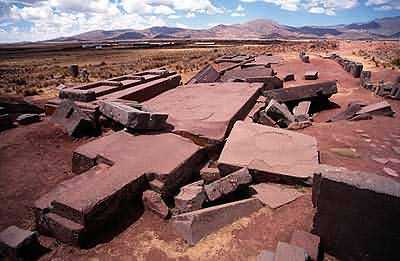
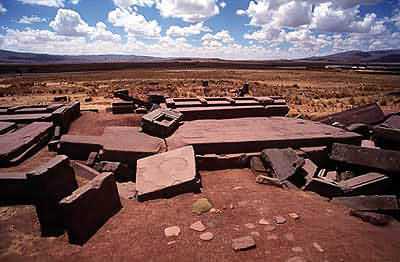
The photos below are the remains of an ancient structure nearby
Tiahuanaco known as the Puma-Punka, which is
littered with giant, precisely shaped blocks, many of which
appear machine made.
The port of Tiahuanaco, called Puma
Punku or "Door of the Puma," which appears to have once been a wharf
with a massive four-part building, is now an area filled with enormous stone
blocks scattered around the ground like matchsticks, with several weighing
between 100 and 150 tons. One block still in place is frequently
estimated to weigh 440 tons.
The quarry for these blocks was on the western shore of Titicaca,
ten miles distant and the means or purpose of transporting such large stones
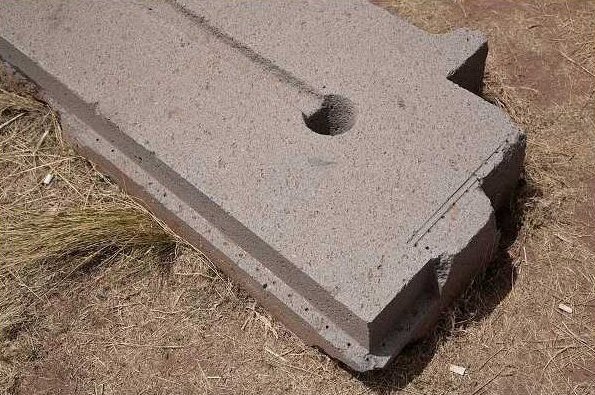
is still a mystery. It has been suggested that there
is evidence of basic machining at Puma-Punka, as the following photo
demonstrates:
The regularly spaced drill marks on this rock are
suggestive of drilled pilot-holes, which appear to have also been used to
assist in splitting the rocks.
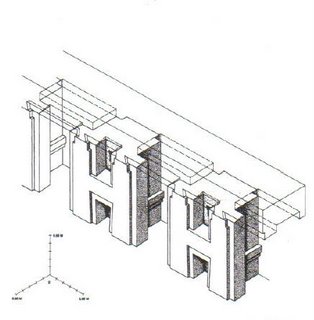
One of the most interesting things
to have transpired about the site is that many of the immense blocks were
built as if from a template, and amazingly appear to interlock as the
picture below illustrates. Such a discovery flies directly in the face of
all our concepts of the construction skills of the ancients. With no
previous examples of masonry at such a sophisticated level, nor on such
great scale leaves one to wonder at the confidence and skills of the
designers and masons.
(Left) Illustrating the sophisticated
way in which the Puma-Punka stones fit together. (Right) A wall of the
Akapana pyramid shows the same modular feature.
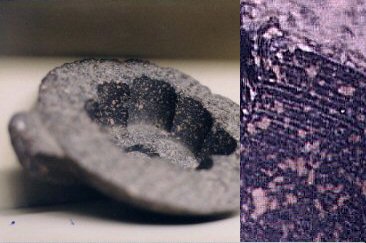
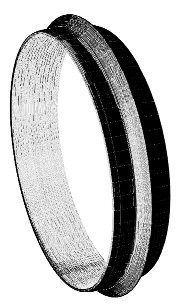
'Oldest
Obsidian Bracelet Reveals Amazing Craftsman's Skills in the
Eighth Millennium BC'.
'Researchers
have recently analysed the oldest obsidian bracelet ever
identified, discovered in the 1990's. Dated to 7,500 BC, the
obsidian bracelet is unique. It is not only the earliest evidence of
obsidian working, but it has a complex shape and a remarkable
central annular ridge, is 10cm in diameter and 3.3cm wide.
The research
has revealed that the bracelet was made using highly specialised
manufacturing techniques. The analysis carried out showed that
the bracelet was almost perfectly regular. The symmetry of the
central annular ridge is extremely precise, to the nearest
degree and nearest hundred micrometers. The surface of the
bracelet (which is very regular, resembling a mirror), required
the use of complex polishing techniques capable of obtaining a
nanometer-scale surface quality worthy of today's telescope
lenses'. (3)
The bracelet
is the first object to have been studied among some sixty other
polished obsidian (and agate) artefacts from the same period.
1). David. D. Zink. The Ancient
Stones Speak. 1979. Musson Book Co.2). Cesar Paternosto. The Stone
and the Thread. 1989. University of Texas Press.3). G. Hancock. Heaven's Mirror. 1998. Michael Joseph
Publ.
4). J. N .Lockyer. The Dawn of
Astronomy. 1964, M.I.T. Press.
5).
http://www.geopolymer.org/archaeology
6). A.
Service & J. Bradbery.
Megaliths and their Mysteries.
1979. Macmillan.
7). D. Trump and D. Cilia. Malta: Prehistory and Temples.
2004. Midsea Books.8). Petrie as quoted
by Smyth, Our inheritance in the Great Pyramid,
1890 Ed, pp20.9). C. Dunn. The Giza
Power Plant. 1998. 10). Kalb, Philine, Megalith-building, stone
transport and territorial markers; evidence from Vale de Rodrigo, Evora,
south Portugal. Antiquity. Sept 1, 1996.11). Kurt Mendelssohn. The Riddle of the
Pyramids. 1974. Book Club Associates.12). Ref:
http://www.catchpenny.org/13).
https://tspace.library.utoronto.ca/citd/holtorf/5.2.7.html

 Extreme Masonry: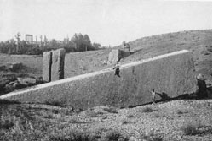
 An
ancient method for moving heavy weights has been revived and
demonstrated in the field by Prof. J. Cunningham of Skidmore
College, USA. Following a system which relies on little more than
long, flexible poles of wood, we are shown how it is possible to
move otherwise apparently impossibly sized stones.
An
ancient method for moving heavy weights has been revived and
demonstrated in the field by Prof. J. Cunningham of Skidmore
College, USA. Following a system which relies on little more than
long, flexible poles of wood, we are shown how it is possible to
move otherwise apparently impossibly sized stones. 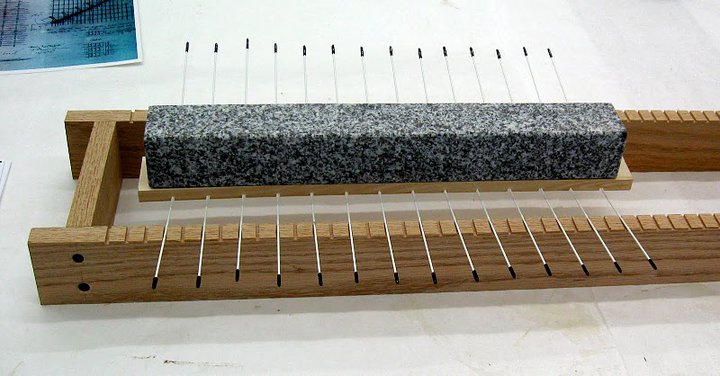
 Article: HeritageDaily.com (Jan, 2012):
