|
Location:
Mainland Orkneys, Scotland. |
Grid Reference:
59� 0' 5" N 3� 13' 51" W. |
 Ring of Brodgar:
(Henge-Circle).
Ring of Brodgar:
(Henge-Circle).
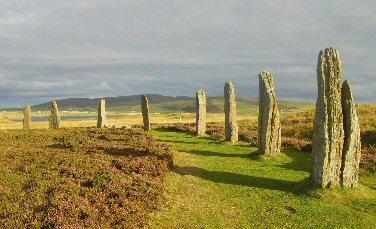
The largest stone circle in
Scotland and one of the finest in Britain. The ambience of this circle is
unique amongst stone circles.
Although only 27 stones
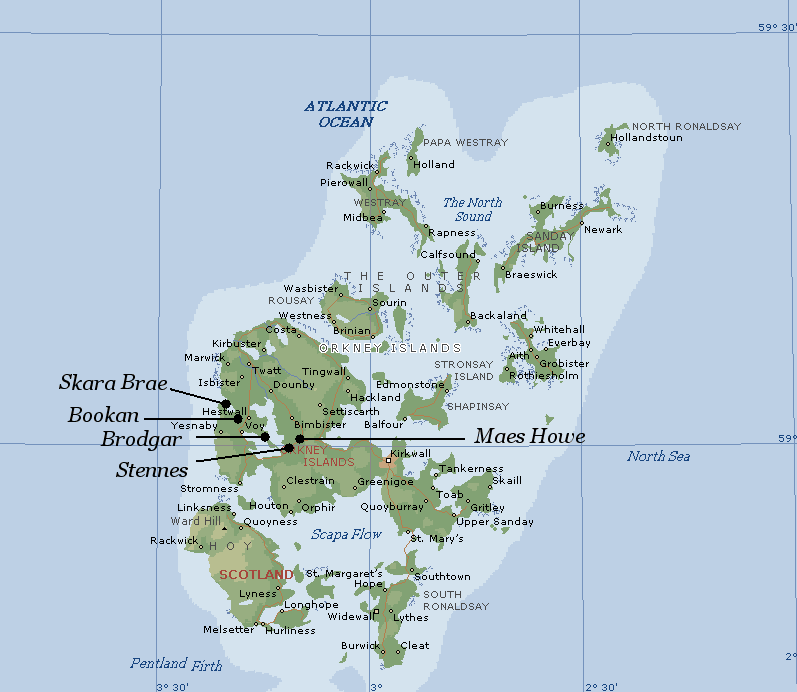
remain, there were once sixty, and a henge. both Stennes and Maes Howe are
visible from this Stone circle, as are the ever-present Hills of Hoy.
Part of the Orkneys complex of Megaliths.
(Orkneys
Map)
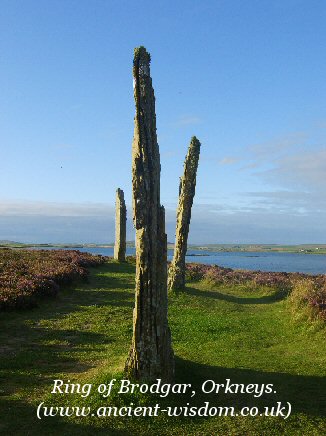
The circle currently has 27 standing
stones still intact, but it is thought there were originally 60. The Brodgar henge is
110 metre (340 ft) in diameter, 10 metres (30 ft) wide and 3.4 metres (10
ft) deep. (100,000 estimated man hours). There are two entrance banks across
the ditch into the ring, in the north-west and the south-east, which seem to
marry with the direction of the summer-setting sun and the winter-rising
sun.
On the farthest point from the road, to the north-east, is a latter flat-topped mound which provides a panoramic viewpoint of the whole ring.
Prof. A. Thom believed that this mound was built to provide an accurate
foresight for the rising moon, and he estimated from astronomical
observations that the platform was probably built 1,000 yrs later than the
henge. He also suggested that the spot was chosen because it provided four
major foresights to observe movements of the moon � known as the major and
minor standstills � which are important to the prediction of its cycles. In
his view, the purpose of the outer bank of the henge was to provide an
artificial horizon for viewing these events.
(16).
The Ring of Brodgar was once known as the
Temple of the Sun and the
Stones of Stenness as the Temple
of the Moon. Between the ring and an outer earth bank lies a ditch
quarried from solid sandstone bedrock that was once no less than 3.6 m (12
ft) deep and 9 m (30 ft) wide. The volume of rock excavated from the ditch
was about 4700 cubic meters (165.700 cubic feet). The bank, where it
survives at all, is very low and has eroded or been carried away over the centuries.
To the SE, 137 m (449
ft) away, lies the
Comet Stone.
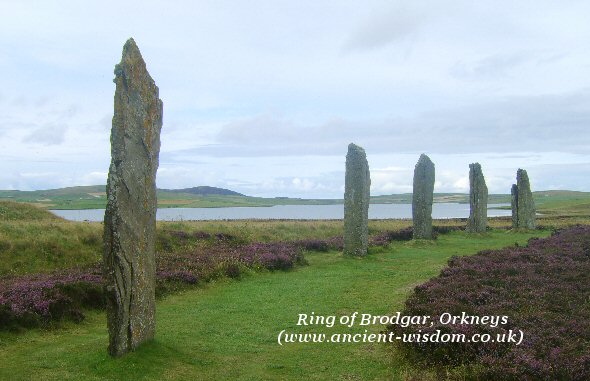
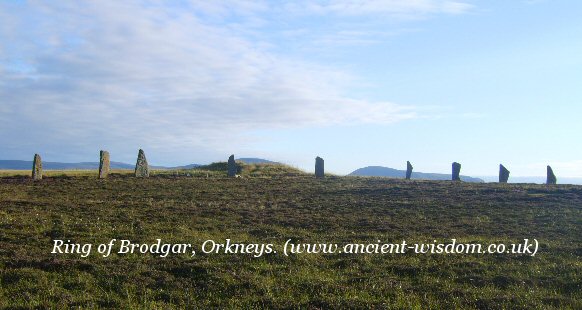
The ring is the biggest stone circle
in Scotland, and is fully 103 metres in diameter. The circle was restored in
1906, and many of the fallen stones were re-erected at that time. There are
now 27 stones of the ring upstanding, with about 13 stumps still also in
position. The tallest stone of the ring is an impressive 4.5 metres tall.
Originally, there would have been 60 stones in the circle, spaced at even
distances apart. All the surviving stones are carefully set with their flat
faces along the perimeter. The external bank and ditch which surrounds the
circle is crossed by entrance causeways at the south-east and north-west.
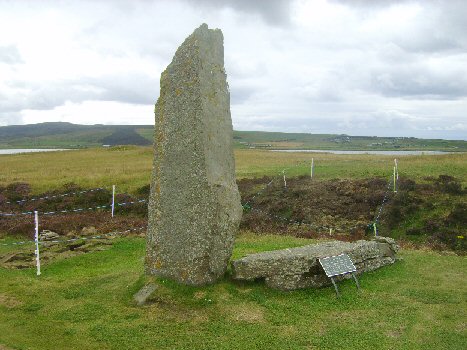
One of the stones was struck by lightning and broken
recently.
There are carvings on four of the
stones. Going clockwise from the north-west
entrance, the carvings are on stone-3 (runes,
undeciphered), stone- (a cross), stone-8 (an anvil), and stone-9 (an ogham
inscription). All of these are from a later period than the circle itself.
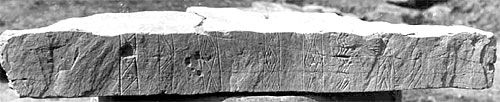
The engraved stone from Brodgar with 'Lozenges'. Photo 1925.
|
The Orkneys Complex.
The Ring of Brodgar is accessible across the ancient man-made causeway that
leads from the Stones of Stenness and Maes Howe. Current archaeology of the
causeway has revealed the presence of a complex (The
Ness of Brodgar) designed to separate the Brodgar side of the causeway
from the Stenness side. Its was designed with a vast 4m wide wall
surrounding numerous complex stone buildings and large enough to run the
width of the causeway, making it an essential part of the landscape.
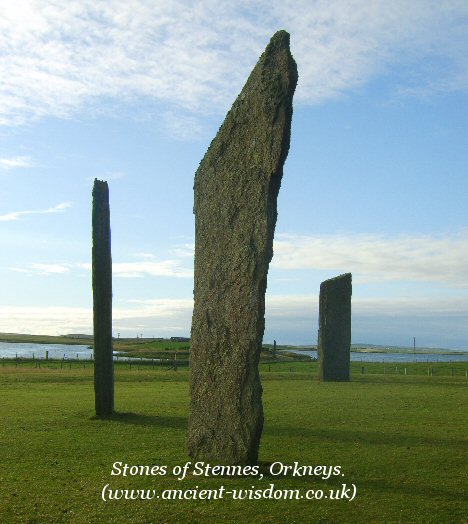
For a long time, Brodgar was looked upon as a
solitary stone circle. This view has now expanded to other sites in
the vicinity, and the whole region can now be seen as a single
prehistoric sacred landscape.
(More about the Orkneys Complex)
|
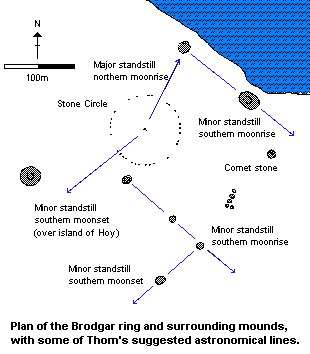
Astronomy at Brodgar:
Prof. A. Thom proposed
that the ring and surrounding mounds were used together to indicate
foresights for observations of the moon at both the major and minor
standstills. A simplified version of the lines suggested are in
the diagram (right). This interpretation is ingenious, but if mounds were
really used astronomically in such a way, this is the only site so far
identified where this is true.
One of the suggested astronomical
lines at the Ring of Brodgar is to the minor standstill southern moonset,
indicated by the cliffs at Hellia on the island of Hoy. These cliffs are
visible from the Brodgar ring on the south-western
horizon.
ARCHAEOLOGISTS TRY TO DATE
THE BRODGAR MEGALITHS ON ORKNEY
Archaeological excavations have continued this summer
(2008) within �The Heart of Neolithic Orkney� World Heritage Site. This
season saw the anticipated re-opening of Professor Colin Renfrew�s 1973
trenches at the Ring of Brodgar, the impressive monument which is
thought to be 4 to 4,500 years old although the date has never been
scientifically confirmed. Archaeologists now wait for summer 2009 to see
what new exciting discoveries can be made made. In the meantime results
for the date of Ring of Brodgar are eagerly awaited.
(More on this subject)
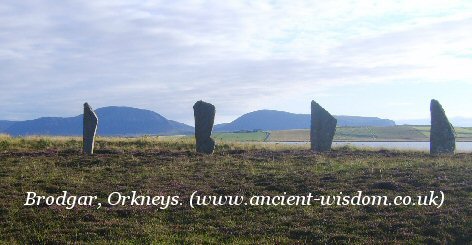
Interaction between the Stones and the
Landscape.
|
The 'Head of Brodgar'.
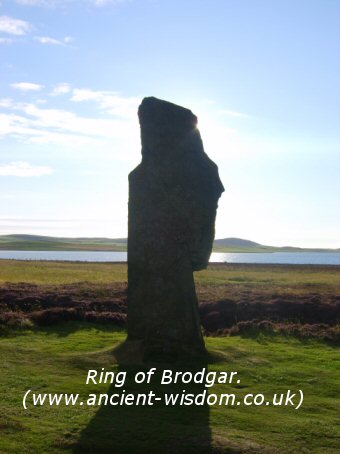
It is not uncommon to find 'faces'
in the stones of the megaliths. This has been reported at such noted
sites as Stonehenge and
Avebury and is visible here at Brodgar
too.
Although the process behind the
phenomena of facial recognition in inanimate objects is now familiar to
us (Simulacrum), the addition of such stones appears to have been
deliberate and would have been a powerful and evocative
inspiration to our prehistoric ancestors who were connected with the
earth and viewed it as a living, mother-earth.
Such stones, with their human
characteristics, personify the megaliths, giving them a 'spirit' which
this belief system, adding to the sacredness of the site.
(More about Simulacrum)
|
(Stone Circles Homepage)
(More about the
Orkneys)
(Other Scottish Sites)
|