|
 The Role of Drugs in Prehistory:
The numerous examples of
'drug' use in prehistory suggests that they may have played an important role in our
imaginative development. For
example, we now know that the flowers associated with
Neanderthal burials had psychoactive properties (Leroi-Gouriian
1984)
The question is not whether drugs were used in
prehistory, but rather - to what extent and what for. Prehistoric rock-art and
shamanic imagery suggest that humans have been using mind altering
substances for thousands of years. It is even suggested that they may
have played an evolutionary role in our mental development.
|
Evidence for Drug use in Prehistory: |
In 1988, David Lewis-Williams of the University of
Witwatersrand in Johannesburg, South Africa, launched one of archaeology's
longest-running controversies when he proposed that the vivid cave paintings of
Upper Paleolithic Europe were produced by shamans whose consciousness had been
altered by drugs or self-induced trances.
(10)
The following examples suggest that his proposition may have substance.
|
Drugs and Shamanism.
In his book 'Supernatural', Graham
Hancock makes the case that shamanic experiences led to the sudden
development of art, symbolic thinking, and early civilization (pp.
29-31).
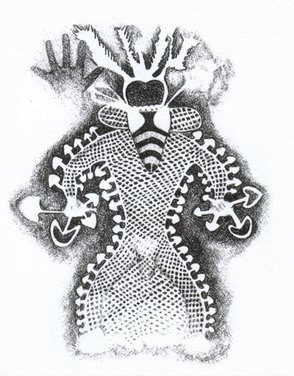
Whether we find its traces in
Australia, Asia Africa, or Europe, it is simply impossible to
overstate the uniqueness and peculiarity of the evolutionary event
by which we were drawn into fully modern consciousness and the fully
modern capacity for symbolism and culture, religion, and art. No
ancestor in the human lineage had ever made use of any form of
symbolism before, and needless to say, no other animal species had
ever done so either. But the switching-on of humanity's
symbol-making capacity between approximately 100,000 and 40,000
years ago was the change that changed everything.
(More about Shamanism)
|
The
Pineal Gland.
There are numerous depictions of
'cobs' or 'pine-cones' in ancient and sacred art. The pine-cone has
a strong symbolism, being a reference to the 'Third-eye' or
'pineal-gland', so named because of its similarity in shape. The
pine-cone is traditionally associated with immortality and
knowledge. The Pineal gland is activated by Light, and it controls
the various biorhythms of the body. It works in harmony with the
hypothalamus gland, which directs the body's thirst, hunger, sexual
desire and the biological clock, that determines our aging process.
"E. A. Wallis Budge has noted that in some of the papyri illustrating the entrance of the souls of the dead into the judgment hall of Osiris the deceased person has a pine cone attached to the crown of his head. The Greek mystics also carried a symbolic staff, the upper end being in the form of a pine cone, which was called the thyrsus of Bacchus. In the human brain there is a tiny gland called the pineal body, which is the sacred eye of the ancients, and corresponds to the third eye of the Cyclops. " Manly P. Hall.
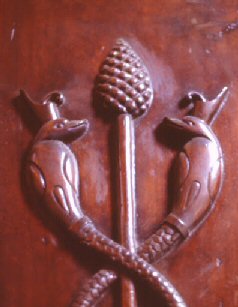
The Egyptian Staff of Osiris, dating back to approximately 1224 BC, depicts two intertwining serpents rising up to meet at a pin-econe.
(Photo: Egyptian Museum, Turin, Italy)
Modern scholars and philosophers have noted the staff�s symbolic parallels to the Indian �Kundalini,� a spiritual energy in the body depicted as coiled serpents rising up from the base of the spine to the Third Eye (Pineal Gland) in the moment of enlightenment. Awakened Kundalini represents the merging and alignment of the Chakras, and is said to be the one and only way to attain the �Divine Wisdom� brining pure joy, pure knowledge and pure love.
In 1997, British Dr. Jennifer Luke extensively documented the Pineal Gland as the primary target for Fluoride accumulation in our bodies (5), where it calcifies the Pineal, inhibiting blood flow and �clogging� the basic functions of our Third Eye. By feeding the public Fluoride from birth, critics claim that our greater spiritual abilities are being dulled by chemically clouding our biological portal to spiritual awareness.
The Psychopharmacologist Rick Strassman believes the Third Eye/Pineal Gland to be the source of the psychedelic Dimethyltryptamine (DMT) in our bodies (6). Strassman has hypothesized that large amounts of DMT are released in our bodies during heightened states of spiritual consciousness, such as birth, death and near-death experiences -- or perhaps during the awakening of our Kundalini in a moment of Enlightenment.
Synthesized DMT, or plants containing DMT are often used as recreational psychedelics, or in shamanic ceremonies, such as the Ayahuasca ceremony originating in South America. DMT and/or Ayahuasca users often report intensely entheogenic experiences of spiritual awakening, contact with entities of supernatural or spiritual origin, and the dilation or compression of time.
The Cult of the Mushroom:
The late
Maya archaeologist Dr. Stephan F. de
Borhegyi, was convinced that
hallucinogenic mushroom rituals were a
central aspect of Maya religion. He
based this theory on his identification
of a mushroom stone cult that came into
existence in the Guatemala Highlands and
Pacific coastal area around 1000 B.C.
along with a trophy head cult associated
with the Mesoamerican ballgame. In most
cases the mushroom imagery
was associated with ritual sacrifice
in the Underworld, with jaguar
transformation and calendar period
endings, and with the decapitation and
resurrection of the underworld Sun God
by a pair of deities associated with the
planet Venus. Mushrooms were also
closely associated with Tlaloc and the
ritual warfare carried out in his name
that is known as Tlaloc warfare.
Link to Full
Article:
http://mayavasepro.webs.com/
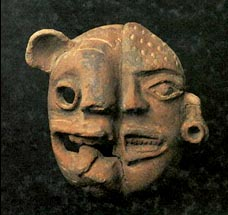
This figure has a Flyagaric mushroom
'Hidden in plain sight'. It symbolises the transformation into
the 'Jaguar God' following consumption of the hallucinogen. This
image appears in Olmec art from as early as 1200 BC.
(7)
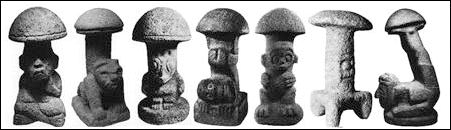
Psychedelic mushrooms were called the 'Holy Children'
by the Mazatec shamen.
(More about Prehistoric
Guatemala)
Terrence Mckenna: The Evolution of Imagination
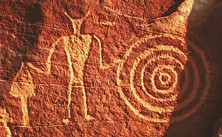 It is well known fact that psychotropic drugs
induce altered states of consciousness. It was argued by Terrence
McKenna that they were a leading stimulant in the evolution of the
human brain, and the origin of language and religion. This theory
did not originate with Mckenna. In 1986, shortly before his passing,
Gordon Wasson put forth his own theory on the origin of religion
from hallucinogenic mushrooms, specifically Amanita muscaria,
with examples from several cultures that he had previously
described, in details. In addition, Wasson also believed that Soma
was responsible for: It is well known fact that psychotropic drugs
induce altered states of consciousness. It was argued by Terrence
McKenna that they were a leading stimulant in the evolution of the
human brain, and the origin of language and religion. This theory
did not originate with Mckenna. In 1986, shortly before his passing,
Gordon Wasson put forth his own theory on the origin of religion
from hallucinogenic mushrooms, specifically Amanita muscaria,
with examples from several cultures that he had previously
described, in details. In addition, Wasson also believed that Soma
was responsible for:
"A prodigious expansion in Man's memory must have been the gift that
differentiated mankind from his predecessors, and I surmise that
this expansion in memory led to a simultaneous growth in the gift of
language, these two powers generating in man that self-consciousness
which is the third of the triune traits that alone make man unique.
Those three gifts - memory, language and self-consciousness - so
interlock that they seem inseparable, the aspects of a quality that
permitted us to achieve all the wonders we now know."
(2)
A modified version of this theory was later
developed by McKenna, in the late 1980's. His theory differed from
Wasson in that Mckenna believed that mushrooms containing the
entheogen psilocybin, and he specifically says Stropharia
cubensis, was responsible for the origin of religion and
development of memory, language and self-consciousness. According to
Mckenna, both events occurred in Africa, and began during the
prehistoric, nomadic, hunting/gathering period of man's existence.
The conclusion that Stropharia cubensis was "The Tree of
Knowledge" was based on the elimination of plants containing
entheogens that are available in Africa. Mckenna
further restricted the plants considered to those having entheogens
with indole compounds, which are characteristically strong visionary
entheogens. With these prerequisites, the list of hallucinogenic
plants was short:Tabernanthe iboga and Peganum harmala
(Syrian Rue). Although both are known to be used by religious cults,
these species were eliminated from consideration. The roots of
Tabernanthe iboga contain the the alkaloid ibogaine, the
entheogen, is required in far greater amounts than would normally be
consumed in a meal by early man. In addition, its usage is only
traced as far back as the 19th. While Peganum harmala may be
found through the arid part of Mediterranean North Africa, there is
no history of its usage here and it, again, must be too highly
concentrated or must at least be combined with dimethyltryptamine (DMT)
before it will produce an hallucinogenic effect. With the
elimination of these two species, McKenna was left only with
psilocybin mushrooms. These mushrooms could be found abundantly
growing on the dung of the hooved animals that grazed in the
grassland areas where they were being hunted. Stropharia cubensis
was singled out because it was the only species thought to produce
psilocybin in concentrated amounts and to be free of other compounds
that may produce side-affects. It was the addition of the
Stropharia to the diet of early man that led to better eyesight
(an advantage for hunters), sex, language, and ritual activity
(religion among them), when eaten. McKenna suggested that the
mushroom augmented the above traits by changing the behaviour of
individuals. These changes in behaviors favored increased usage
of language, leading to an increase in vocabulary to communicate
when hunting and gathering. Although evolution was occurring on the
genetic level, due to increase in mutations from the change in diet
that had occurred, according to McKenna, social evolution,
due to the mushroom consumption was responsible for the above
changes.
'At the same time that language was
developing, religion also began. When taken at levels that cause
intoxication, a feeling of ecstasy occurs, with hallucination and
access to what the user would perceive as the realm of the
supernatural. This led to the origin of the shaman whose duty is
to communicate with the unseen mind of nature'.
|
Article: The Lycaeum.
(1992)
The idea that the use of hallucinogens should be a source of
inspiration for some forms of prehistoric rock art is not a new
one. After a brief examination of instances of such art, this
article intends to focus its attention on a group of rock
paintings in the Sahara Desert, the works of pre-neolithic Early
Gatherers, in which mushrooms effigies are represented
repeatedly. The polychromic scenes of harvest, adoration and the
offering of mushrooms, and large masked "gods" covered with
mushrooms, not to mention other significant details, lead us to
suppose we are dealing with an ancient hallucinogenic mushroom
cult. What is remarkable about these ethnomycological works,
produced 7,000 - 9,000 years ago, is that they could indeed
reflect the most ancient human culture as yet documented in
which the ritual use of hallucinogenic mushrooms is explicitly
represented. As the Fathers of modern ethno-mycology (and in
particular R. Gordon Wasson) imagined, this Saharian testimony
shows that the use of hallucinogens goes back to the Paleolithic
Period and that their use always takes place within contexts and
rituals of a mysfico-religious nature.
(Click here for full article)
|
What were they smoking in Egypt ?
In a one-page article appearing in
Naturwissenschaften, German scientist Svetla Balabanova (1992) and
two of her colleagues reported findings of cocaine, hashish and
nicotine in Egyptian mummies. The findings were immediately
identified as improbable on the grounds that two of the substances
were known to be derived only from American plants - cocaine from
Erythroxylon coca, and nicotine from Nicotiana tabacum. The
suggestion that such compounds could have found their way to Egypt
before Columbus' discovery of America seemed patently impossible.
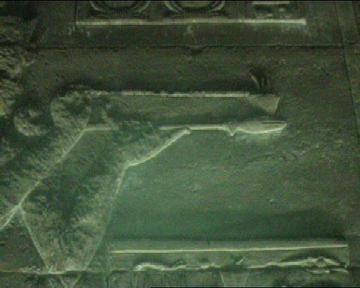
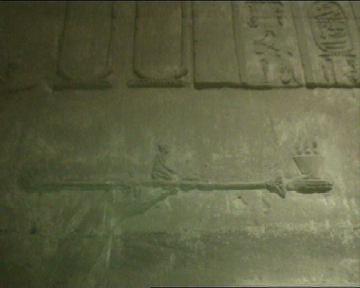
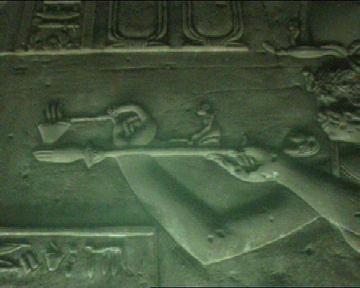
These 'images' on the temple walls of Dendera
(left) and Abydoss (right), suggest
an association between the the ceremonial nature of the temples
and inhaling a 'burning substance'...
The study was done as part of an ongoing
program of investigating the use of hallucinogenic substances in
ancient societies. The authors themselves were quite surprised by
the findings (Discovery, 1997) but stood y their results despite
being the major focus of criticism in the following volume of
aturwissenschaften. Of the nine mummies evaluated, all showed
signs of cocaine and hashish Tetrahydrocannabinol), whereas all
but one sampled positive for nicotine. It is interesting too that
the concentrations of the compounds suggest uses other than that
of abuse. (For example, modern drug addicts often have
concentrations of cocaine and nicotine in their hair 75 and 20
times higher respectively than that found in the mummy hair
samples.) It is even possible that the quantities found may be
high due to concentration in body tissues through time.
Without question, the study has sparked an interest in various
disciplines. As Balabanova et. al. predicted, "...the results open
up an entirely new field of research which unravels aspects of
past human life-style far beyond [sic] basic biological reconstruction."
Follow this link for a full and balanced review of the subject:
http://www.faculty.ucr.edu/~legneref/ethnic/mummy.htm
|
Ancient Greece: The Prophetic Oracles.
Both Minoan and Greek images attest to an association between the gods and
poppies as seen below.
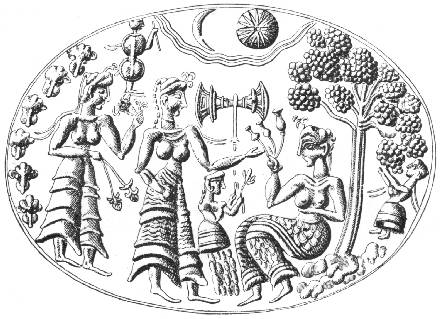
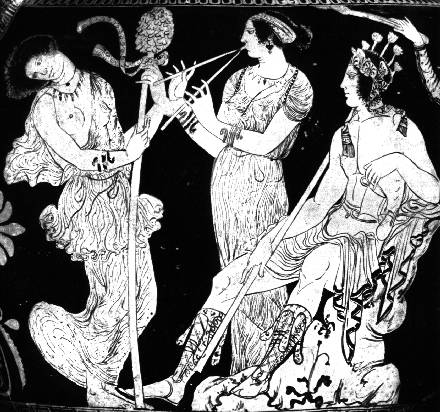
Left: Gold signet ring, Knossos. 1500 BC. Demeter, seated beneath the Double Axe
and the World Tree, hands three poppy heads to Persephone. Right: Sacramental
vase in the National Archeological Museum of Taranto. 450 BC, depicts Demeter's
son, Dionysos, wearing a crown of opium poppies.
An association between poppies and the oracles can be seen
in the exquisite example of Minoan art below. What has been termed the 'Sleeping
Goddess' or the 'Poppy Goddess' is one of several figurines discovered inside a
room without windows. Her posture is that of worship or prayer, as are the other
figurines. The symbolism of the poppies is clear considering its reputation, and
the cuts on the sides are additional indications that the poppies are functional
(either medicinally or for inducing a trance-state).
The prophetic abilities of
the Delphic oracles were renowned for over a
thousand years.
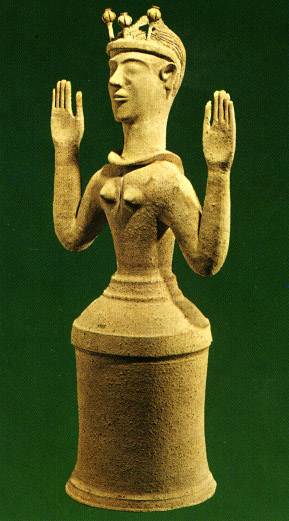
This Minoan figurine of the female in worship
stance wearing a diadem of opium poppy heads, each painted with
a slit for extraction of the sap.
(More about the Oracles)
Drugs and the Eleusian Mysteries.
'Some scholars believe that the power of the
Eleusinian Mysteries came from the kykeon's functioning as a
psychedelic agent. Barley may be parasitized by the fungus ergot,
which contains the psychoactive alkaloids lysergic acid amide (LSA),
a precursor to LSD and ergonovine. It is possible that a
psychoactive potion was created using known methods of the day. The
initiates, sensitized by their fast and prepared by preceding
ceremonies, may have been propelled by the effects of a powerful
psychoactive potion into revelatory mind states with profound
spiritual and intellectual ramifications'.
'While modern scholars have presented evidence supporting their view
that a potion was drunk as part of the ceremony, the exact
composition of that agent remains controversial. Modern preparations
of kykeon using ergot-parasitized barley have yielded inconclusive
results, although Shulgin and Shulgin describe both ergonovine and
LSA to be known to produce LSD-like effects. Terence McKenna argued
that the mysteries were focused around a variety of Psilocybin
mushrooms, and various other entheogenic plants, such as Amanita
muscaria mushrooms, have also been suggested but at present no
consensus has been reached. The size of the event may rule out
Amanita or Psilocybe mushrooms as active ingredient, since it is
unlikely that there would have been enough wild mushrooms for all
participants. However a recent hypothesis suggests that Psilocybe
cultivation technology was not unknown in ancient Egypt, from which
it could easily have spread to Greece'.
'Another theory is that the kykeon was an Ayahuasca analog involving
Syrian Rue (Peganum harmala), a shrub which grows throughout the
Mediterranean and also functions as a monoamine oxidase inhibitor.
The most likely candidate for the DMT containing plant, of which
there are many in nature, would be a species of Acacia. Other
scholars however, noting the lack of any solid evidence and
stressing the collective rather than individual character of
initiation into the Mysteries, regard entheogenic theories with
pointed skepticism'.
More about the Eleusian Mysteries
|
Drugs in Prehistoric Asia:
Article:
(Aug 15, 2012) News.Com.Au.
'Ancient Siberian Princess Buried
With Cannabis'.
'Tattoo's
as complex and abstract as any
modern design have been found on the
body of Siberian princess buried in
the permafrost for more than 2500
years.
Two
warriors recovered from the same
burial site in the permafrost of the
Ukok Plateau were similar
fantastical creatures.
(Quick-link)
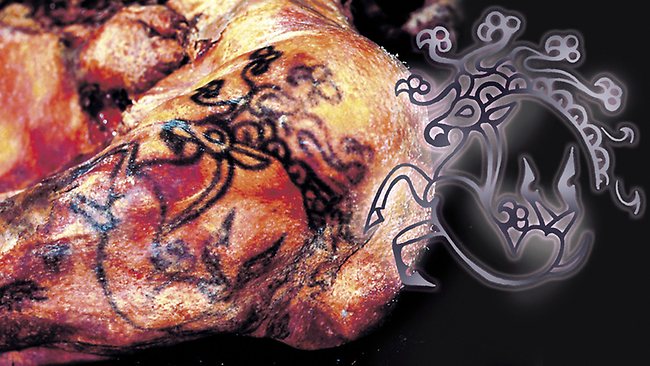
Buried with the
'princess' were six
saddled-and-bridled horses, bronze
and gold ornaments - and a small
canister of cannabis'.
(More
about Tattoo's in Prehistory)
Article (2008) Discovery.Com:
'Prehistoric Cultivated Marijuana Stash
Found in China'
According to a recent report, researchers have discovered almost two
pounds of marijuana
"cultivated for
psychoactive purposes"
in the Gobi Desert, an area located in southern Mongolia and the northern
Inner Mongolia region of China. According to the researchers, the marijuana
stash is about 2,700 years old. The following is an excerpt from the news
report
Nearly two pounds of still-green plant
material was found
in
the grave of a
2,700-year-old light-haired, blue-eyed Caucasian
man in the Gobi Desert, and has
been identified as the world's oldest marijuana stash,
according to a paper in the latest issue of the Journal of
Experimental Botany.
A barrage of tests proves the marijuana possessed potent
psychoactive properties and casts doubt on the theory that the
ancients only grew the plant for hemp in order to make clothing,
rope and other objects. It is possible
that the man was a shaman but it is unknown whether the marijuana
was grown for spiritual or medical purposes.
The substance has also been found in two of the 500 Gushi tombs
excavated so far in northwestern China.
(Quick-link)
(More about the
'Cherchen' Mummies)
At Merv oasis, a little west of
Urumchi (China), there is a religious complex that dates back to the second Millenium BC. In its most important room, the 'White room', are storage vessels
which contain traces of Poppy and Ephedra. Apparently, the poppy derivatives
provide such stunning highs that the ephedra had to be used to prevent the
shaman from losing consciousness.
(9)
The Pazyryk barrows, (5th-3rd
centuries B.C.) Russia: The Pazyryk tombs
discovered by Rudenko were in an almost perfect
state of preservation. Unique artefacts found during
excavation of the burial mounds (kurgans) of Pazyryk
in the Eastern part of the High Altai, at a height
of 1,600 metres above sea level include skeletons
and intact bodies of horses and embalmed humans,
together with a wealth of artefacts including
saddles, riding gear, a chariot, rugs, clothing,
jewelry, musical instruments, amulets, tools, and,
interestingly, an "apparatus for inhaling hemp
smoke". Also found in the tombs were fabrics from
Persia and China, which the Pazyryks must have
obtained on journeys covering thousands of miles.
(8)
|
Drug-use in the Pre-Columbian Americas.
Article: Bulletin
on Narcotics. Issue 1, 1971; 3-14. By Albert Hofmann.
'The country of origin of the majority and most
important of the so-called magic, i.e. hallucinogenic drugs, is
Central America. Magic drugs were already of great importance in the
old Indian cultures of Mexico. The Spanish chroniclers and naturalists
who came to the country soon after the conquest of Mexico by Cortez
mentioned in their writings a great number of plants with
intoxicating, stimulating, or narcotic effects; these plants were
unknown in the Old World and were used by the Indians both in their
medical practices and in their religious ceremonies. The cultic use
and divine worship given to many of these drugs met with the
disapproval of the Christian missionaries, who attempted by any means
possible to liberate the Indians from this devilry. They were,
however, only partially successful in this respect. The native
population secretly continued using the drugs considered by them as
holy even after having been converted to Christianity.
Three magic drugs were used mainly by the Aztecs
and neighbouring tribes in their religious ceremonies and medical
practices, which were strongly influenced by magical concepts; these
drugs are still used today for the same purpose by the witch doctors
in remote districts of Mexico. They are: 1. peyotl, a cactus species;
2. teonan�catl, certain foliate mushrooms; 3. ololiuqui, the seeds of
bindweeds.
The first of these magic drugs to be analyzed
was peyotl, the cactus Anhalonium Lewinii, this being done at the turn
of the century. The alkaloid mescaline was found to be the
psychoactive principle of peyotl. These investigations are to be
considered as the first scientific studies in the field of
psychotomimetics, and the two pioneer researchers who carried them
out, Louis Lewin and Arthur Heffter, deserve a place of honour in the
history of psychotomimetic research'.
(Link to Full Article)
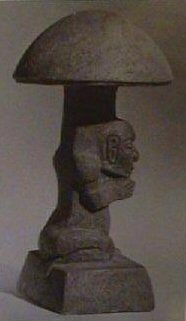 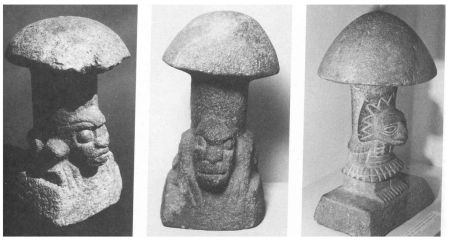 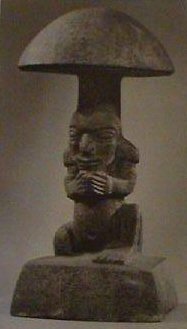
Samples from the cache of ten
mushroom figurines discovered in Guatemala city and dated at
around 100 - 300 BC.
(More about Guatemala)
Highly decorated
snuffing tablets and tubes are often found as grave goods during the periods
3,4,5,6,7,8. Until now the type of drugs consumed in this paraphernalia has been
unclear. From the modern city of Arica, naturally mummified human bodies with
abundant hair provided a unique opportunity to test for hallucinogenic plants
consumed in Andean prehistory. Analysis by gas chromatography and mass
spectrometry demonstrated the presence of harmine. The Banisteriopsis vine,
commonly called Ayahuasca, was the probable source. This is the first confirmed
evidence of psychoactive plant consumption in pre-Hispanic Andean populations
along the Atacama coastal region. Of the 32 mummy hair samples analyzed 3 males
tested positive for harmine. This alkaloid aids in the catalysis and synergic
effects of powerful hallucinogenic drugs. The consumption of harmine was likely
related to medicinal practices and not exclusively ingested by shamans. Another
important aspect of this evidence is that Banisteriopsis is an Amazon plant. It
does not grow in the Atacama coastal region. Thus, our findings reveal extensive
plant trade networks in antiquity between the coast, desert, highlands, and
Amazon basin.
Link:
http://precedings.nature.com/documents/1368/version/1
'Examinations of hair samples exhibit remnants of
psychoactive substances in many mummies found in Tiwanaku culture
mummies from Northern Chile, even those of babies as young as 1 year
of age, demonstrating the importance of these substances to the
Tiwanaku'. (10).
(More
about Tiahuanaco)
(More about about
Pre-Columbian America) |
|
Hallucinogens and the Neolithic Megaliths: |
Gavr'inis, France - Thursday, January 27, 2005 - Bangor Daily News.
'Neolithic
pottery artefacts found in the chamber contain traces of cannabis'.
(3)
Balfarg, Scotland: The Balfarg henge is a part
of a larger prehistoric ceremonial complex in Fife, Scotland. grooved-ware
pottery found at the site dates to around 2900 BC. Some of the vessels may have
been used to hold black Henbane (Hyoscyamus niger) which is a poison but
also a powerful hallucinogen. This discovery is briefly explored in the journal
Antiquity in the article ' The use of henbane as a hallucinogen at Neolithic
ritual sites: a re-evaluation'
(1)
Carrowmore, Ireland. (Site 4) - Dated about
4,600 BC, contains the remains of a passage-tomb which may be the earliest
in the country. Such an early date, however, is controversial. This tomb
is one of the smallest complete sites in the cemetery and produced the remains
of over 65 fragments of antler pins, including seven pieces with mushroom-shaped
heads, as well as over 30 kilos of cremated human bone.
Skara Brae, Orkneys:
Hallucinogenic Alcohol: 5,000 year old traces of cereal-based fermented alcohol
- laced with hemlock and henbanewere discovered near Skara Brae in the Neolithic
metropolis of Orkney. (Gourlay, 2001)
However important, alcohol is
nowhere near the full story of induced Neolithic consciousness change.
In many cultures, psychoactive drugs and their effects are viewed as
vehicles for making contact with other worlds, in particular those of
the ancestors in the context of temple-centred ceremony. Rudgley (1999,
p.137-141) has proposed cannabis and/or opium as likely candidates in
the early western Neolithic and a growing body of opinion points in the
same direction. (Devereux, 1997: Sherratt, 1997; Thomas, J., 1998) The
Orkney brew described above, it will be remembered, was blended with
henbane and hemlock. Henbane, bearer of the trance-inducing,
hallucinatory (and extremely toxic) drug Hyoscyamine, is one of what
Sherratt (1996) terms �the Saturnine herbs�. Sherratt recounts how
during the 1980�s henbane was recovered from carbonised Neolithic
porridge, eaten from Grooved Ware pottery in the context of a mortuary
structure, Balfarg/Balbirnie in Fife, Scotland. Discovery in the 1920's
of three burial chambers at the Jersey La Houghe Bie site adds weight to
Sherratt's thesis. David Keys reports that the chambers "...contained
21 pottery vessels marked with a burnt, resin-like material.
Archaeologists believed that this was from drugs, possibly opium or
hashish."
(6)
(Herb-Lore)
(Shamanics)
(Eleusian Mysteries)
(Earth-mother-earth)
|