|
Location:
The hill of Hissarlik, Plain of Troad,
Turkey. |
Grid Reference:
39�
55� N. 26� 14� E. |
  Troy (Illium):
('Fortress Citadel').
Troy (Illium):
('Fortress Citadel').
First excavated by Dr. Heinrich Schliemann, in 1870,
the city of Troy was discovered after a lifelong quest which led Dr.
Schliemann to the plain of Troad, on the north-west coast of Turkey. Until
its discovery, it was considered a fictional city from the 'Illiad', by Homer.
The discovery is one of several 'mythological' places that have been unearthed
over
the last two hundred years.
Location of the famed 'Priam Treasures'.
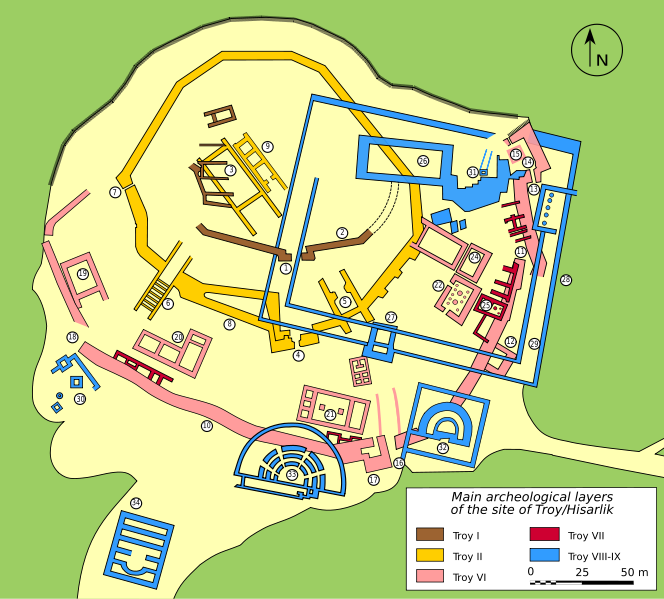
(Click here for Map of
site)
|
Troy
(Illium):
('Illius') - (Hissarlik - 'Place of Fortresses') |
Description
-
Ilus,
the son of Tros founded Troy in 3000 BC, and the name Troy was derived from
him.
Immortalised by the writings of Virgil and Homer, the ruins of Troy were
first found by Charles McLaren in 1822 (2), and
excavated by Dr. Heinrich Schliemann, in 1870. The city of Troy was re-discovered after a lifelong quest which led Dr.
Schliemann to the plain of Troad, on the north-west coast of Turkey. Until
its discovery, it was considered a fictional city in the 'Illiad', by Homer.
The discovery is one of several 'mythological' places that have unearthed in
the last two hundred years.
Dr. Schliemann discovered four settlements or cities beneath Illium, one below the other at Hissarlik, of which he determined the third deepest to have been Troy
proper, where he found the so called 'Priam treasures'. 'These four
cities were separated from each other by layers of ash and other marks of
conflagration' (1). The German archaeologist Heinrich Schliemann
excavated Troy from 1870 to 1890. His theft of treasure from Troy and his
damage to the site will be always remembered in Turkish archaeological
history. Wilhelm Dorpfeld followed to excavate Troy after Schliemann. Today,
a new German team is still working to rebuild Troy ruins by using new
advanced technologies since 1988.
Chronology -
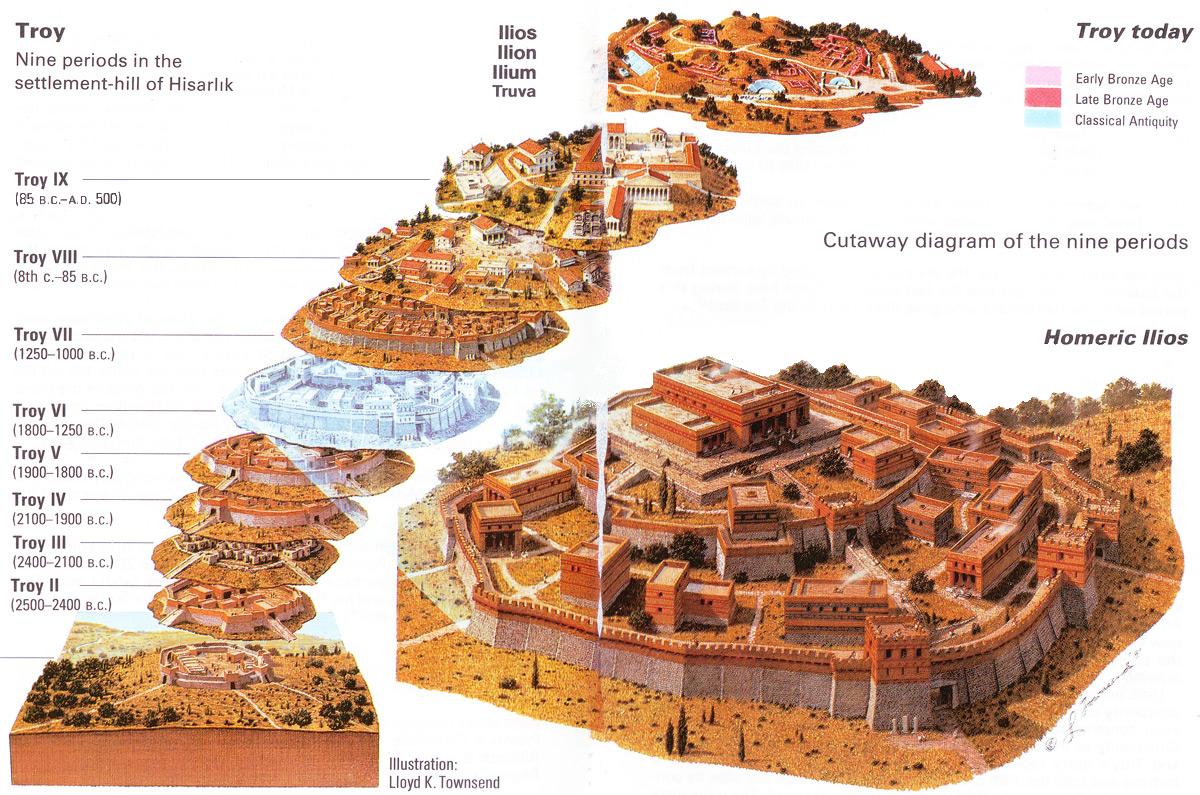
There are nine levels at Troy; Troy I to V relates
roughly with early Bronze Age (3000 to 1900 BC). Its inhabitants were
known as Trojans in this period. Troy VI and VII were built in the
Middle and Late Bronze Age. Troy VIII to IX belongs to Hellenistic and
Roman Ilion (Latin Ilium). Troy was destroyed many times and rebuilt
each time.
- Troy I 3000�2600 (Western Anatolian EB 1)
- Troy II 2600�2250 (Western Anatolian EB 2)
- Troy III 2250�2100 (Western Anatolian EB 3
[early])
- Troy IV 2100�1950 (Western Anatolian EB 3
[middle])
- Troy V: 20th-18th centuries BC (Western Anatolian
EB 3 [late]).
- Troy VI: 17th�15th centuries BC.
- Troy VIh: late Bronze Age, 14th century BC
- Troy VIIa: ca. 1300�1190 BC, most likely
candidate for Homeric Troy.
- Troy VIIb1: 12th century BC
- Troy VIIb2: 11th century BC
- Troy VIIb3: until ca. 950 BC
- Troy VIII: around 700 BC
- Troy IX: Hellenistic Ilium, 1st century BC
Ref: (http://www.answers.com/topic/troy)
(Click
here for exploded view showing seperate layer of inhabitation)
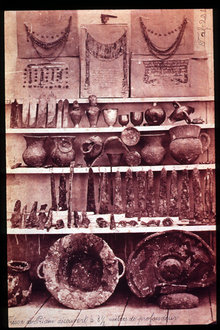 The 'Priam treasures'
- '...all probably came from Troy II or Troy III (c. 2,200 BC) - quite
the wrong period for Homers Troy; Troy IV, whose destruction probably
occurred in 1,260 BC'.(1)
Schliemann confessed that he smuggled the jewels out of Turkey with his
wife and that... The 'Priam treasures'
- '...all probably came from Troy II or Troy III (c. 2,200 BC) - quite
the wrong period for Homers Troy; Troy IV, whose destruction probably
occurred in 1,260 BC'.(1)
Schliemann confessed that he smuggled the jewels out of Turkey with his
wife and that...
'...sadly all but one
pair of earrings and a few other small objects disappeared from Berlin
in 1945...'
(1).
A Turkish team is currently trying to retrieve the Trojan treasures,
which are at the Pushkin Museum.
The archaeological site of Troy was
added to the UNESCO World Heritage list in 1998.
Myth and Legend -
The
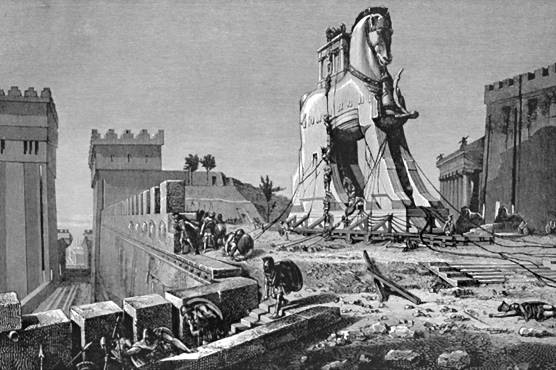
City of troy featured in Homers Iliad, from which Dr. Schliemann was
originally inspired, and is said to have used in his determination of the
location of the lost city. Homer mentions that Troy had been destroyed by
Hercules long before the Greeks under Agamemnon, and this legend may refer
to the destruction of the first city.
(Other Prehistoric Turkish sites)
|