|
 The Phaistos Disc:
(Clay Disc - Unknown Script)
The Phaistos Disc:
(Clay Disc - Unknown Script)
|
The Phaistos disc was
discovered in 1908 in the Minoan palace of Phaistos on Crete, suggesting a dating of
middle to late Minoan origin.
Although there have been
several attempts to decipher the images on the disc, none have been proven
conclusively as the script remains unique and its meaning unknown.
The symbols on both sides
were embossed on the clay slab while it was still wet.
It has been argued that the
Phaistos disc
is a fake, but until modern Thermoluminescence testing is carried out (a
procedure currently refused by the Greek authorities), the
truth will remain unknown.
|
 |
| The
Phaistos Disc:
Phaestos Disc |
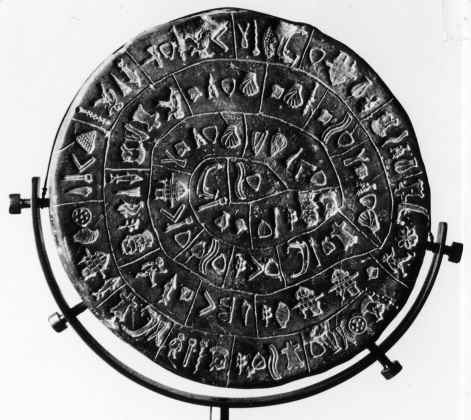
The Phaistos Disc is a disk of fired clay discovered in
the
Minoan palace of
Phaistos, possibly dating to the middle or late Minoan
Bronze Age (2nd
millennium BC). It is about 15 cm (5.9 in) in diameter and covered
on both sides with a spiral of stamped symbols. Its purpose and meaning,
and even its original geographical place of manufacture, remain
disputed, making it one of the most famous mysteries of
archaeology. This unique object is now on display at the
archaeological museum of
Heraklion in Crete, Greece.
The disc was discovered in 1908 by the Italian archaeologist
Luigi Pernier in the Minoan palace-site of Phaistos, on the south
coast of
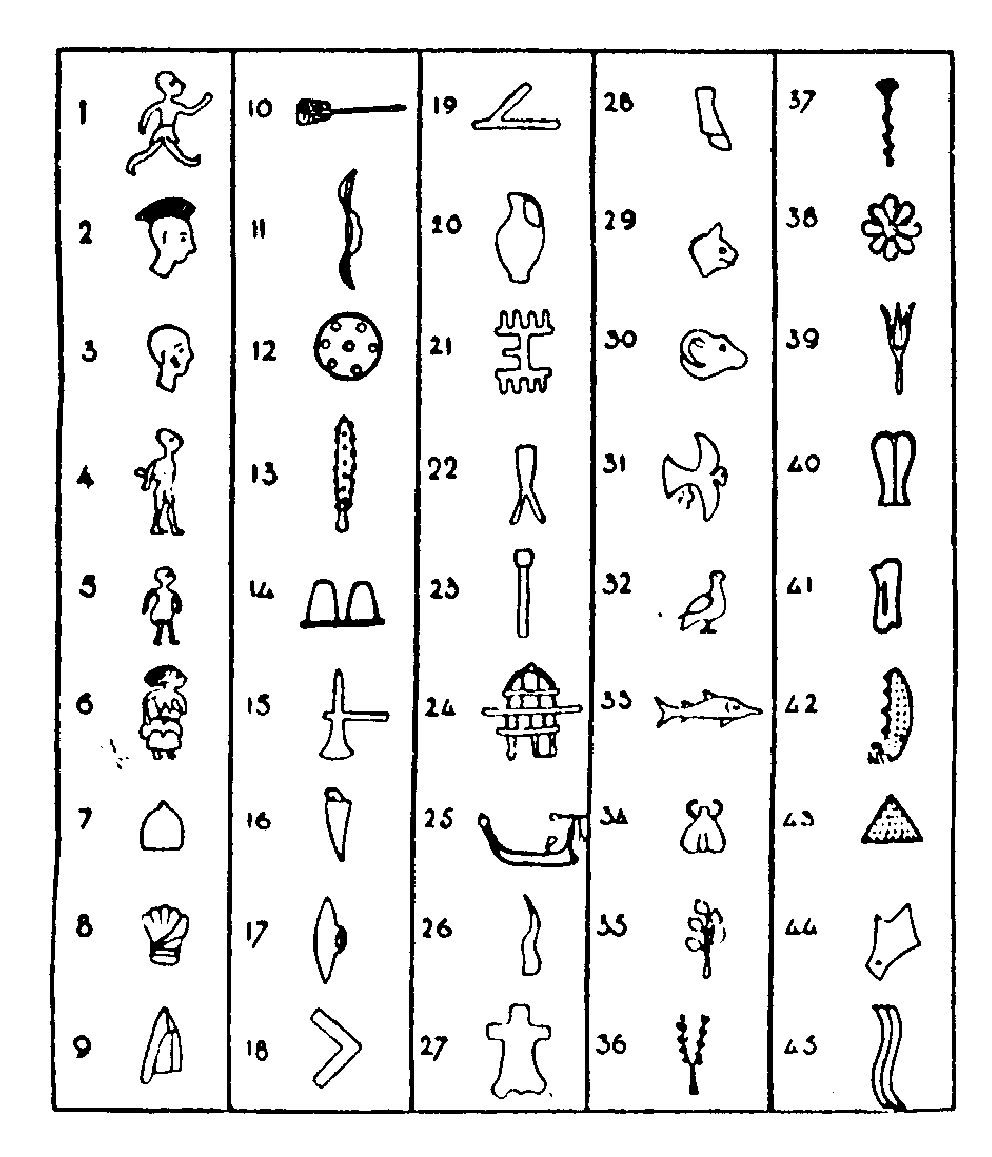
Crete, and features 241 tokens, comprising 45 unique signs, which
were apparently made by pressing pre-formed hieroglyphic "seals" into a
disc of soft clay, in a clockwise sequence spiraling towards the disc's
center.
Although the Phaistos Disc is generally accepted as authentic by
archaeologists, a few scholars have forwarded the opinion that the disc
is a
forgery or a hoax.
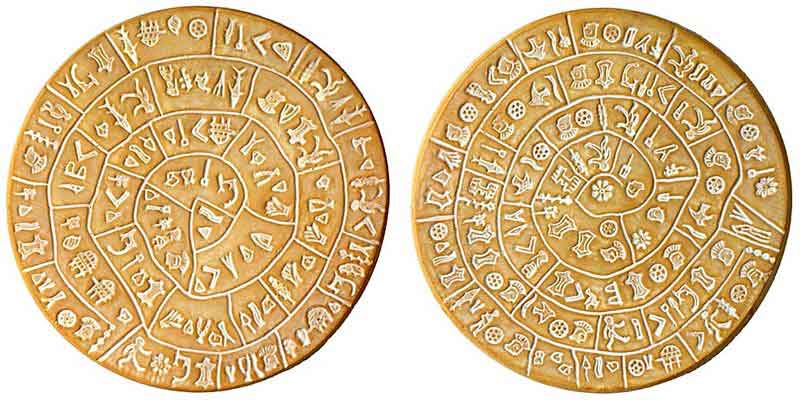
The Phaistos disc front and back.
(Click here for larger detailed image of
characters)
|
The Authenticity of the disc: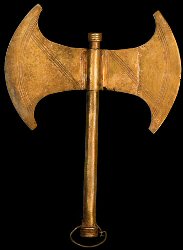
The Phaistos Disc is currently generally accepted as authentic by
archaeologists
(2). The assumption of authenticity is based on the
excavation records by Luigi Pernier. This assumption is also supported by the
later discovery of the Arkalochori Axe with similar but not identical
glyphs.
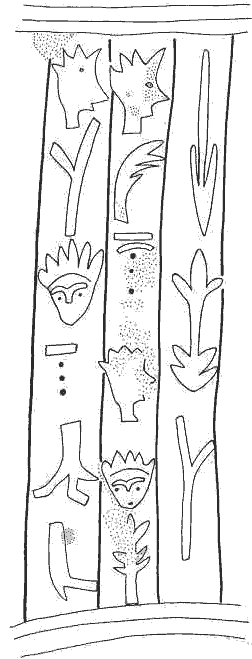
The bronze Arkalochori Axe (right),
is a second millennium BC Minoan votive double axe excavated by Spyridon
Marinatos in 1934 in the Arkalochori cave on Crete. It is notable for
being engraved with an inscription of fifteen symbols.
 (Click here for image of symbols) (Click here for image of symbols)
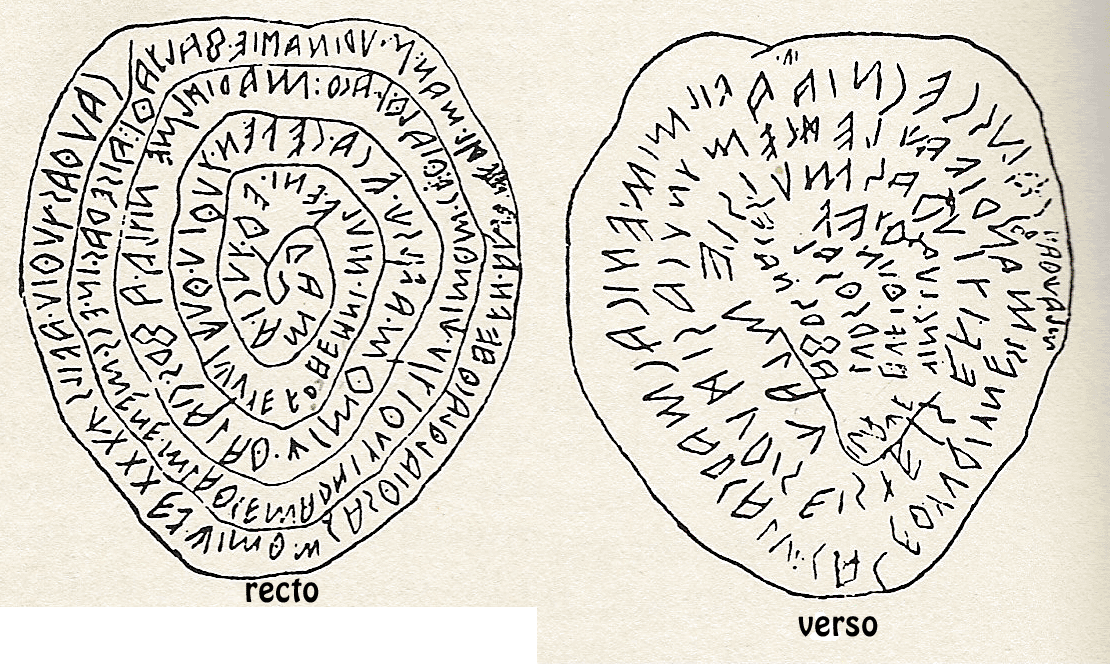
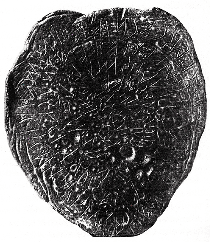
The Phaistos disc shows similarities to
the 'Magliano disc' (left), discovered in Italy in the 1880's. The style
is the same in that it is a rounded disc with the text in Etruscan,
spiralling inwards. The Phaistos and the Magliano are the only two discs
of this kind ever discovered. It is suggested that
Luigi Pernier, the discoverer of the Phaistos disc, would have had prior
knowledge of this disc.
(Click here for larger image of both sides of the Maglino disc)
The only means of testing for sure is through
Thermo-luminescence, something which the Herakleion Archaeological
Museum in Crete is not prepared to do at present...? |
Deciphering the disc.
Many attempts have been made to decipher
the code behind the disc's signs. While it is not clear that it is a
script, most attempted
decipherments assume that it is; most additionally assume a
syllabary, others an
alphabet or
logography. Attempts at decipherment are generally thought to be
unlikely to succeed unless more examples of the signs are found, as it
is generally agreed that there is not enough context available for a
meaningful analysis.
It is generally agreed that the text
runs in a clockwise sequence spiralling towards the disc's
centre (as some of the symbols appear closer together at the centre).
Groups of symbols are divided by
vertical lines, as though separating them into 'words' or 'conceptual
groups', thirty on one side and thirty one on the other... (Calendar
months..?)
There are a number of signs (16) marked with an oblique stroke;
the strokes are not imprinted but carved by hand, and are attached to
the first or last sign of a "word", depending on the direction of
reading chosen. Their meaning is a matter of debate.
(Prehistoric Greece)
|