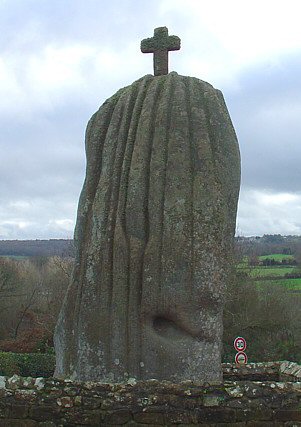
The
depth, number and distinction of lines are suggestive of the 'human-touch'.
Note how the stone has
the appearance of a 'face' on it.. (surely not..!!)
(Other examples of Megalithic Simulacrum)
The Engravings:

The St. Uzec menhir is estimated to weigh around sixty tons,
and is dated to around 2,500 BC. The stone was Christianized in the seventeenth century
by the devout Jesuit missionary, Padre Maunoir.
Within the
monument itself a cross was planted.
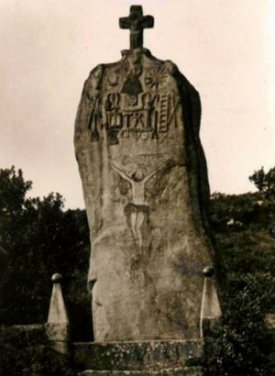
On the south face a series of
objects has been carved in stone: they are instruments of 'the Passion'.
Left and right the moon (death) and sun (the resurrection).
At left is a spear and a stick that evokes the arrest which correspond to
the right, a spear and the sponge on a reed.
Between the two, the pitcher and a hand gesture reminiscent of Pilate,
then, a woman on her knees, and beneath it, the veil of Veronica.
The rooster's denial of St. Peter is perched on the
column of flagellation.
A ladder evokes the
descent of the cross.
On each side we see the
two whips. Below, from
left to right, the sword of St. Peter, who cut off the ear of Malchus,
the high priest's servant, a lantern leads to arrest in the Garden of
Olives, then clamps and a hammer in where is the money of Judas.
The last line finally, the seamless
robe, dice that the Roman soldiers cast lots for the garments of
Christ, the three nails.
The skull is that of Adam:
a legend, indeed, reported that it was buried on Golgotha. On the scale, two crossed bones may mean the descent into
hell.
From ancient representations of the menhir of Saint Uzec
(see
drawing, right, from the Antiquities Cotes-du-Nord,
Knight Freminville. 1837),
we
learn that at the origin of the Christianization of the menhir, all
these objects were painted.

 St. Uzec:

