|
Location:
Visocica
hill, Visoko. Bosnia Hertzogovnia. |
Grid Reference:
43� 59' 20.10" N,
18� 10' 12.97" E. |
 Visocica Hill, Bosnia:
(The Pyramids of the 'Sun', 'Moon', 'Earth' and 'Dragon')
Visocica Hill, Bosnia:
(The Pyramids of the 'Sun', 'Moon', 'Earth' and 'Dragon')
|
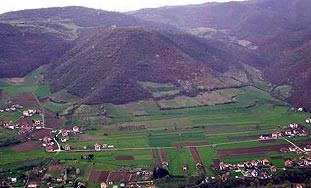 The main Bosnian 'Pyramid', otherwise named Visocica Hill, is
claimed to be one of
very few pyramids in Europe. It is located in the
heart of Bosnia, in the town of Visoko. It apparently has all the important
elements: four perfectly shaped slopes pointing toward the cardinal points, a
flat top and an entrance complex. Because of its similarities to the Pyramid of
the Sun in
Teotihuac�n, Mexico, it has been named the �Bosnian Pyramid of the
Sun� 'Bosanska Piramida Sunca'. There are also a three smaller pyramids
on the site, the Bosnian Pyramid of the Moon 'Bosanska Piramida Mjeseca',
Bosnian Pyramid of Earth, 'Bosanska Piramida Zemlje' and Bosnian Pyramid
of the Dragon 'Bosanska Piramida Zmaja'. The main Bosnian 'Pyramid', otherwise named Visocica Hill, is
claimed to be one of
very few pyramids in Europe. It is located in the
heart of Bosnia, in the town of Visoko. It apparently has all the important
elements: four perfectly shaped slopes pointing toward the cardinal points, a
flat top and an entrance complex. Because of its similarities to the Pyramid of
the Sun in
Teotihuac�n, Mexico, it has been named the �Bosnian Pyramid of the
Sun� 'Bosanska Piramida Sunca'. There are also a three smaller pyramids
on the site, the Bosnian Pyramid of the Moon 'Bosanska Piramida Mjeseca',
Bosnian Pyramid of Earth, 'Bosanska Piramida Zemlje' and Bosnian Pyramid
of the Dragon 'Bosanska Piramida Zmaja'.
Should it be determined that these
structures are indeed pyramids, then their discovery is of great importance. The
fact that they are actually pyramids has been strongly contested by various
agencies, although at present 'the jury is still out' on this issue. The world
awaits...
An international team of archaeologists
began digging in April 2006.... |
The same year a
declaration was published by the 'European Association of
Archaeologists' claiming the whole scheme to be 'a cruel hoax
on an unsuspecting public'.
(Link
to Declaration)
...'The hill is clearly pyramid shaped'...
BBC
Article (2006): Dig for Ancient Pyramid in Bosnia.
Semir
Osmanagic is leading the project to uncover the 'pyramid'. Initial
excavations have revealed a narrow entrance to what could be an
underground network of tunnels.
A
team of rescue workers from a local coal mine, followed by
archaeologists and geologists examined a tunnel, thought to be 2.4
miles (3.8km) long. The team found two intersections with other
tunnels leading off to the left and right. Their conclusion was that
it had to be man-made. "This is definitely not a natural formation,"
said geologist Nadja Nukic.
Satellite photographs and thermal imaging revealed two other, smaller
pyramid-shaped hills in the Visoko Valley, which archaeologists
believe the tunnels could lead to. Cashing in Workers also discovered
a paved entrance plateau and large stone blocks that could be part of
a pyramid's outer surface.
He has
already named the three hills the pyramids of the Sun, Moon and
Dragon.
The
work will continue for around six months, with the first results
expected in the next three weeks. Two experts from Egypt are also due
to join the team in mid-May.
According to anthropologists there is evidence of 7,000-year-old human
settlements in the valley. German archaeologists also recently found
24,000 Neolithic artefacts one metre below ground. Mr Osmanagic says
the hill is a classic example of cultures building on the top of other
cultures.
The
town was Bosnia's capital during the Middle Ages, and a medieval
fortress used by Bosnian kings sits atop Visocica. The fortress was
built over an old Roman Empire observation post, which in turn was
constructed over the ruins of an ancient settlement.
(Ref:
WWW.BBC.CO.UK)
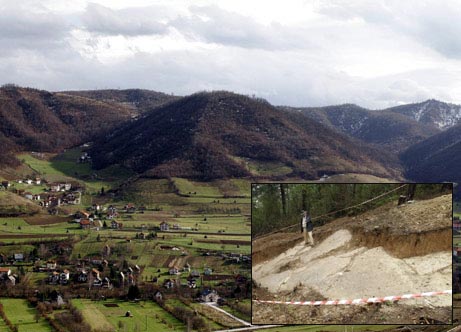
Update (17.5.2006).
|
The Bosnian Pyramids.
An
Egyptian geologist who has joined Bosnian researchers unearthing
what are thought to be Europe's first pyramids believes they
bear similar hallmarks to the ancient structures in his
homeland, an official said on Wednesday.
Dr Aly Abd
Barakat concluded that the blocks on the eastern face of the
'pyramid of the Sun', are of a similar construction to those
found in Egyptian pyramids - (the blocks are handmade and
polished). In Egypt, stones were polished to reflect the
sunlight. Baraket believes that the blocks, 4m x 1.5m in size,
were brought from a different location.
After
studying excavations on the northern side of the pyramid,
Baraket concluded that the blocks were handmade and had been
created using a mould to form the blocks, which consist of an
ancient 'concrete-like' mix. He also noticed a white line 0.5cm
thick between
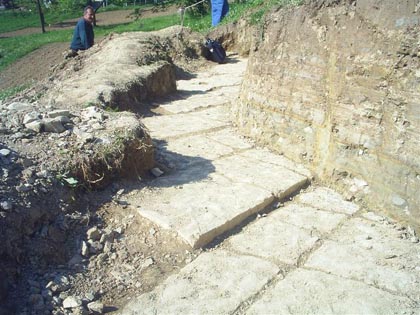 the blocks, indicating a cement-like substance had
been used to adhere them together. the blocks, indicating a cement-like substance had
been used to adhere them together.
Barakat also
visited the 'pyramid of the Moon', at the base of Pljesevica
Hill, and concluded that the 'steps' which form the sides of
this pyramid were also made by human hands.
Aly Abd
Alla Barakat, of the Egyptian Mineral Resources Authority,
believes large stone blocks found near Sarajevo were man-made
and polished in the same way as the pyramids of Giza, said the
Bosnian Pyramid Foundation's Mario Gerussi.
"Barakat
has also found the presence of a special material linking the
stone blocks which is identical to that used for pyramids in
Giza," he added.
Barakat
had extensive knowledge of the pyramids in Giza and had been
recommended for the Bosnian mission by Zahi Hawass, one of the
world's foremost Egyptologists, said Gerussi.
Over the
next month, he is to work with Bosnian experts at Visoko valley,
30km north of Sarajevo, which is believed to be hiding three
major pyramids.
Since the
digging work began in mid-April on one of the three hills there
believed contain pyramids, researchers have unearthed a number
of large stone blocks.
Semir
Osmanagic, a self-styled Bosnian explorer who initiated the
work, says he believes the blocks are part of a pyramid's
surface.
Previously, satellite images showed that the hills in the valley
cooled a lot faster than their surroundings, proving the
substance of the structures was less dense and therefore
probably made by men.
Also, the
structures are precisely aligned with the four points of the
compass.
The
excavation work at Visoko, led by the foundation of local
archaeologists and volunteers, will last 200 days and is
expected to cost �125 000.
While
most Bosnians are hopeful the pyramids will be found, a group of
the country's archaeologists and historians have dismissed
Osmanagic's mission as a "farce".
|
|
Zahi Hawass on Barakat.
On the issue of whether Barakat was there on
official business, Zahi Hawass stated: "Mr. Barakat, the Egyptian
geologist working with Mr. Osmanagic, knows nothing about Egyptian
pyramids. He was not sent by the SCA, and we do not support or
concur with his statements." The supposed pyramid, Dr. Hawass
says, is "evidently a natural geologic formation" and that "Apart
from its general outline, this hill bears absolutely no
resemblance to the Egyptian pyramids." He concludes that, "Mr.
Osmanic's theories are purely hallucinations on his part, with no
scientific backing."
(Ref:
Archaeology.org)
(Click here for Dr. Hawass' letter) |
Update. (Aug. 2008)
|
International Scientific Conference about
Bosnian pyramids announced.
On
August 25-30th, 2008 the first ever International Scientific
Conference for the Bosnian Valley of the Pyramids (ICBP) will take
place at the Congress Hall of Municipality in Old Town Sarajevo.
After the first
three seasons of excavations of the Bosnian Pyramids
the Foundation has gathered enough scientific evidence, through
the efforts of scientists and professionals from around the world,
to be presented at the ICBP. Leading researchers for the pyramid
project believe that this compelling evidence will verify the
existence of the Bosnian Pyramid.
|
In an almost unbelievable act of
serendipitous irony, an archaeological site in Donje
Mostre, in the Bosnian Valley of the Pyramid, has
unveiled a Neolithic artefact that has been dated to
6,000-3,000 BC. The discovery was made by students
of the German University of Kiel on September 23,
and was announced by Zilke Kujund�ic, who is
actually one of the main opponents to the pyramid
project, having filed numerous petitions for the
work to be stopped, claiming the entire project is a
hoax.
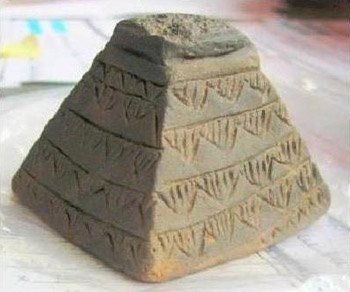
The small ceramic pyramid � in some reports also
referred to as a benben stone, because of apparent
visual similarities with such stones in Egypt � is a
major discovery, showing that local people,
millennia ago, created ceramic objects in the shape
of a pyramid. One can only wonder why, noting that
Donje Mostre is also the location where giant
rectangular stone blocks have been found, some of
which are definitely manmade. Kujund�ic has refused
to admit she might be wrong, stating that the find
is �not related� to the nearby pyramids. Meanwhile,
Kujund�ic was also accused of not having shared the
discovery with the local Visoko museum.
Gallery of
Images: Visocica Hill.
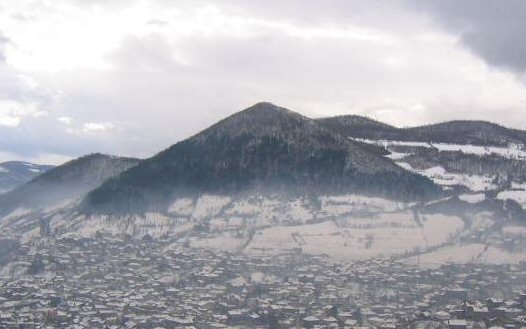
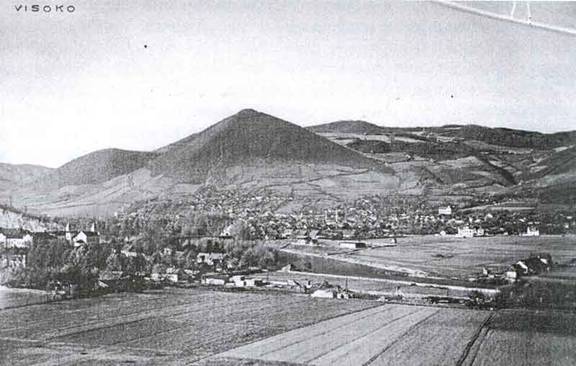
It must be
emphasised that the geological features of Visocica Hill are
overwhelmingly considered by scientists to be natural and
not man-made as claimed by Semir Omanagic,
who is heading up the project.
In effect,
what we have here is either the worlds largest pyramid or the worlds
largest hoax.!
(Other
European Pyramids)
(Pyramids Homepage)
(Vinca Culture) |