|
Location:
Sindh Province, Indus River, Pakistan. |
Grid Reference:
27�19' N, 68�07' E. |
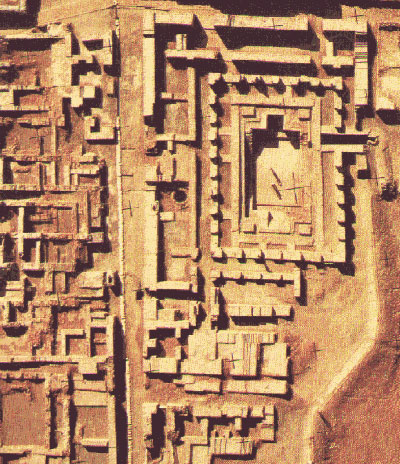
 Mohenjo Daro:
(Indus Valley City).
Mohenjo Daro:
(Indus Valley City).
Mohenjo-Daro was a city located in the south of Modern
Pakistan in the Sindh Province, on the right bank of the Indus River. It
was built between four and five thousand years ago, and lasted until 3,700
BP. It was part of the Harrapan Civilization, and at its peak, the city had at least
35,000 residents.
This was a sophisticated society with a wide-ranging
diet that consisted of meat from both wild and domesticated animals and a
variety of cultivated wheat, barley, peas and lentils � a huge step
forward in human progression from the nomadic hunter-gatherers.
Mohenjo Daro was one of the largest centres of the
Indus Valley Civilisation, experiencing the transition from Stone-age to
Bronze-age.
(Map of Indus Valley)
Article: BBC News. (June, 2012). 'Could
This Ancient City be Lost Forever.?'
'The
salt content of the ground water is eating away at the
bricks that, before excavation, had survived thousands
of years...Even the Mohenjo Daro Museum has been looted,
with many of its famous seals among the artefacts
stolen..."most of the attempts at conservation by the
authorities have been so bad and so amateur they have
only accelerated the damage"...Some experts have gone so
far as to suggest that the entire site should be buried
again to halt its decline..'
'...One
saving grace may be that some of the city remains
unexcavated...'
(Link
to Article)
|
| Mohenjo
Daro: (Mound of the Dead). |
Mohenjo Daro is probably the best known of the Indus Valley civilisation
cities. Similar in style and date to Harappa in north
Pakistan, it was built almost entirely of kiln-fired bricks
between 2,500 and 2,100 BC (12).
Originally square in outline, the City was laid out along the
lines of a grid. Twelve main streets divided it, of which eleven
blocks were residential with the twelfth section being dominated
by the Citadel.
The city had a sophisticated sewage system with
regular manhole covers. Public latrines for every block and
sewers large enough to walk in. (1)
House drains, which were enclosed systems, were made of clay
pipes and were connected to the sewers by open brick gutters.
Mohenjo-daro was first
occupied about 3,500 BC, and it was continuously occupied until
between 1700 and 1300 BC. Its Indus occupations lasted between
about 2600-1900 BC. (2)
Article: PAKISTAN SITE - OLDER THAN MOHENJO DARO?
An archaeological site dating back about 5,500 years and believed
to be older than Mohenjo daro has been found in Pakistan's southern
Sindh province. A team of 22 archaeologists found some
semi-precious and precious stones and utensils made of clay,
copper and other metals during an excavation at the site in
Lakhian Jo Daro in Sukkur district.
"At present, we can say that it (the site) is older than
Mohen jodaro," Ghulam Mustafa Shar, the director of the Lakhian Jo
Daro project said. The find is believed to date back to the Kot
Diji era, experts said. Shar said the remains of a 'faience' or
tin-glazed pottery factory had been found at the site. It is
believed to be of the era of mirror factories in Italy that date
back to some 9,000 years. A painting has also been found at the
site and the discovery of more such items could establish the site
as 9,000 years old, like the remains found at Mehargarh in
Balochistan and Jericho in Palestine, Shar said.
|
The
Great Baths:
One of the most spectacular structures at
Mohenjo is the 'Great Bath', which is astonishingly well preserved and
measures 180 feet north to south and 108 feet east to west. It is described
as a �vast hydropathic establishment and the most imposing of all the
remains unearthed at Mohenjo-Daro,� by Sir Marshall.
(17)
�Its plan is
simple: in the centre, an open quadrangle with verandahs on its four sides,
and at the back of three of the verandahs various galleries and rooms; on
the south, a long gallery with a small chamber in each corner; on the east,
a single range of small chambers, including one with a well; on the north a
group of several halls and fair-sized room. In the midst of the open
quadrangle is a large swimming-bath, some 39 feet long by 23 feet broad and
sunk about 8 feet below the paving of the court, with a flight of steps at
either end, and at the foot of each a low platform for the convenience of
bathers, who might otherwise have found the water too deep. The bath was
filled from the well�, and the waste water was carried off through a covered
drain�The Great Bath had a least one upper storey as evidenced by a
stairway. A large amount of timber, possibly richly carved, must have
gone to the building of the upper storey, judging from the quantities of
charcoal and ashes found in the course of excavation".
The outer walls of the
Great Bath measure between 7 and 8 feet in thickness and were lined with
bitumen.
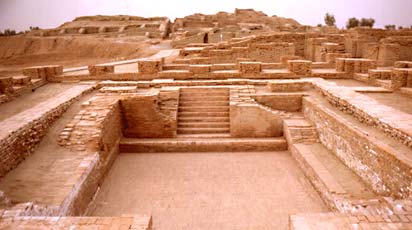
It is possible that this 'Bath' was a
common purification pool.
|
The Indus Valley Civilisation.
More than a thousand
settlements are now known from the Indus valley civilisation. The
civilisation is known to have had a unity of culture, art, script, and
technology (even weights and measures). The largest city, Mohenjo Daro is
thought to have reached a population of approximately 30,000, suggesting a
total population of approximately 5 million people.
(1)
It was the
largest of the four ancient civilizations of Egypt, Mesopotamia, India and
China. However, of all these civilizations the least is known about the
Indus Valley people. This is because the Indus script has not yet been
deciphered. There are many remnants of the script on pottery vessels, seals,
and amulets, but without a "Rosetta Stone" linguists and archaeologists have
been unable to decipher it.
(Full list of Indus Valley Symbols)
Indus Valley Civilisation (IVS) -
It has been
surprising to archaeologists that the site layouts and artefacts
styles throughout the Indus region are very similar. It has been
concluded these indicate that there was uniform economic and social
structure within these cities.
(6)
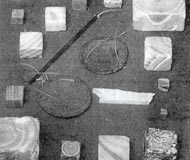
An additional indicators of this is that the bricks used to build at these
Indus cities are all uniform in size ( 7cm x14cm x
28cm). Sun-dried bricks were used for infill, and burnt bricks were used for
the drain and sewer linings. It would seem that a standard brick size was
developed and used throughout the Indus cities. Besides similar brick size
standard weights are seen to have been used throughout the region as well.
(7) The weights that have been
recovered have shown a remarkable accuracy. They follow a binary decimal
system: 1, 2, 4, 8, 16, 32, up to 12,800 units, where one unit weighs
approximately 0.85 grams. Some of the weights are so tiny that they could
have been used by jewellers to measure precious metals.
( 8)
(More about the Indus Valley Civilisation)
|
Other Interesting Discoveries
at Mohenjo Daro:
Stone �seals� with intricate carving were found (see below),
that correspond to similar Iraqi seals from the mid-third millennium BC.
(1). Some of the seals found were
almost exact the same as those found in ancient Sumerian sites.
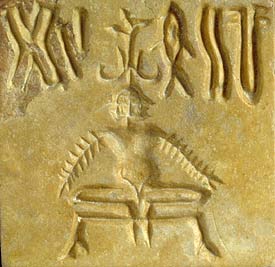
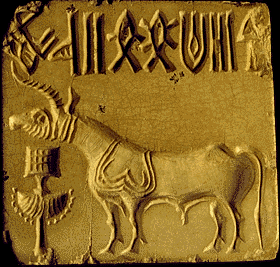
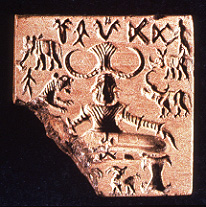
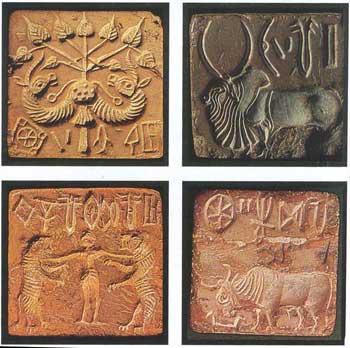
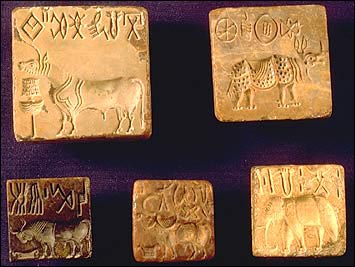
Note: Appearance of Sumerian 'Gilgamesh'
figure bottom left.
Ancient Mesopotamian texts speak of
trading with at least two seafaring civilizations - Makkan and Meluha - in
the neighbourhood of India in the third millennium B.C. This trade was
conducted with real financial sophistication in amounts that could involve
tons of copper. The Mesopotamians speak of Meluha as an aquatic culture,
where water and bathing played a central role. A number of Indus Valley
objects have been found buried with Mesopotamians.
The ancient script of the Indus valley people has been found in another
location,
Easter Island; which is exactly diametrically opposed to Mohenjo daro.
This curious coincidence has yet to be properly explained. The Indus Valley
Culture was extant thousands of years before the Easter Island culture
began, yet the similarity between the two scripts is uncanny.
(Comparisons of Indus
Valley and Easter Island scripts.)
|
Article: Computers unlock secrets of
Indus-Valley script. (Science Daily: 2009)
A team led by a University of
Washington researcher has used computers to extract patterns in
ancient Indus symbols. The study, published this week in the
Proceedings of the National Academy of Sciences, shows distinct
patterns in the symbols' placement in sequences and creates a
statistical model for the unknown language.
Despite dozens of attempts,
nobody has yet deciphered the Indus script. The symbols are
found on tiny seals, tablets and amulets, left by people
inhabiting the Indus Valley from about 2600 to 1900 B.C. Each
artefact is inscribed with a sequence that is typically five to
six symbols long.
Some people have questioned
whether the symbols represent a language at all, or are merely
pictograms of political or religious icons.
The new study looks for
mathematical patterns in the sequence of symbols. Calculations
show that the order of symbols is meaningful; taking one symbol
from a sequence found on an artefact and changing its position
produces a new sequence that has a much lower probability of
belonging to the hypothetical language. The authors said the
presence of such distinct rules for sequencing symbols provides
further support for the group's previous findings, reported
earlier this year in the journal Science, that the unknown
script might represent a language.
"These results give us
confidence that there is a clear underlying logic in Indus
writing," Vahia said.
Seals with sequences of Indus
symbols have been found as far away as West Asia, in the region
historically known as Mesopotamia and site of modern-day Iraq.
The statistical results showed that the West-Asian sequences are
ordered differently from sequences on artefacts found in the
Indus valley. This supports earlier theories that the script may
have been used by Indus traders in West Asia to represent
different information compared to the Indus region.
(Full Article) |
The Dancing Girl. (Bronze Figurine):
2,500 BC. Mohenjo Daro.
The famous "Dancing girl" found in Mohenjo-daro is an artifact
that is some 4,500 years old. The 10.8 cm long bronze statue of the dancing
girl was found in 1926 from a house in Mohenjo-daro.
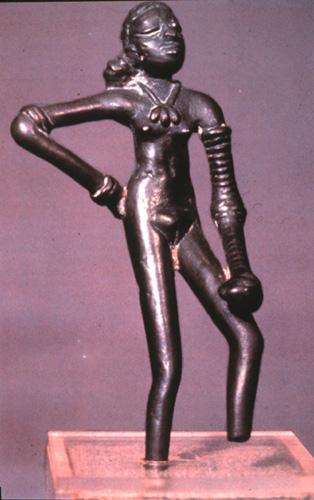
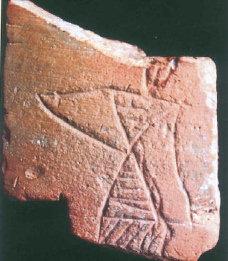
Dancing girl, Mohenjo Daro (Left),
Potsherd, Haryana (Right)
|
Article: The Hindu. Wednesday, Sep 12, 2007:
In a rare discovery, the Archaeological Survey of India has
found at Bhirrana, another Harappan site in Fatehabad district
in Haryana, a red potsherd with an engraving that resembles the
�Dancing Girl,� the iconic bronze figurine of Mohenjo daro.
While the bronze was discovered in the early 1920s, the potsherd
with the engraving was discovered during excavations by the ASI
in 2004-05.
(Link to Full Article:
http://www.hindu.com/2007/09/12/stories/2007091255372200.htm ) |
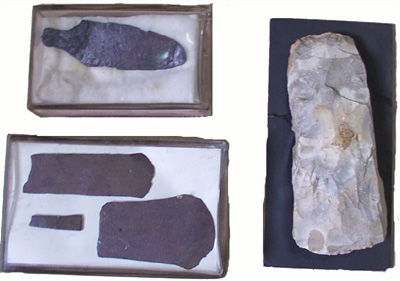
Tools.
Several Copper and
Bronze objects have been discovered at Mohenjo Daro, they were first cast
and then hammered to required shape. Stone axes and flake-knives have also
been found in several houses of Mohenjo-Daro illustrating that the city
witnessed the transition from 'stone-age' to 'Bronze-age'.
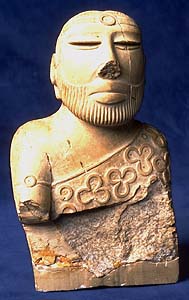 The
'priest-king': The
'priest-king':
The statue of the so called priest-king has a circular
space on the forehead. A small gold disc, unearthed in the same location
fits perfectly into this space and is suggestive of a possible forerunner to
the 'Third-eye' or 'Bindi' of Hindu myth. Shiva had a third eye called the
'burning eye'.
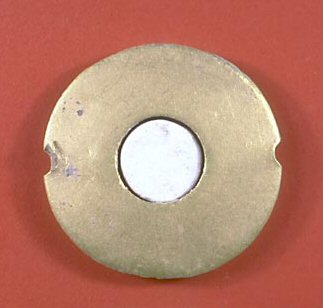
The gold disc.
The Myth of a Nuclear Explosion.
For several years, it was insinuated that a devastating event
had occurred at Mohenjo daro, killing everyone on the spot. The 'War of the
Gods' in the Mahabharata was said to be historical narrative of a nuclear
explosion. Although archaeology on the site only revealed 37 bodies in ten
years digging, and at different levels of occupation
(3), and there are no reports to substantiate
suggestions of a higher than normal level of background radiation, the myth
still lingers on.
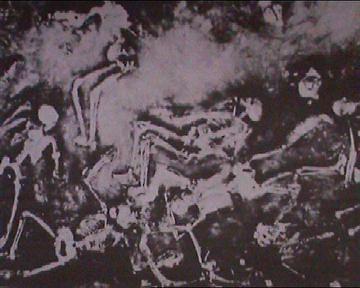
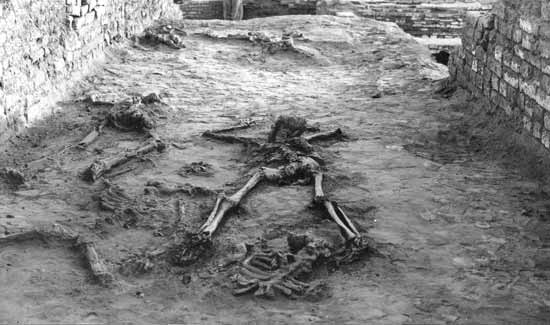
The last levels of occupation show skeletons with sword-cuts , holding hands and lying in
the streets They most certainly record a tragic end to what was once one of
the capital cities of a great civilisation.
|
Authorities look
away as plunder of Mohenjodaro continues
Article: By Dilshad Azeem. Tuesday, February 24,
2009
ISLAMABAD: Authorities appear to be dragging their feet in
preventing the pilferage of precious artefacts from the Mohenjodaro
site, according to an official document.
A revised master plan for conservation and promotion of cultural
tourism at the Mohenjodaro site awaits the federal government�s nod
at a time when President Asif Zardari and PPP senior vice-chairman
and Prime Minister Yousuf Raza Gilani are at the helm of affairs.
But the Mohenjodaro site, falling under the federal government�s
jurisdiction, is regrettably facing a double whammy: non-stop
pillage of antiques and severe seepage and damage, reveals the
document made available to the news.
Major features of the revised master plan are archaeological
conservation, acquisition of land, further excavation and
conservation, landscaping and environment development, a tourism
monument plan and an interpretation system.
http://www.thenews.com.pk/daily_detail.asp?id=164200
|
(Harrapa)
(Prehistoric
India)
(Indus
Valley Civilisation)
|

