|
Location:
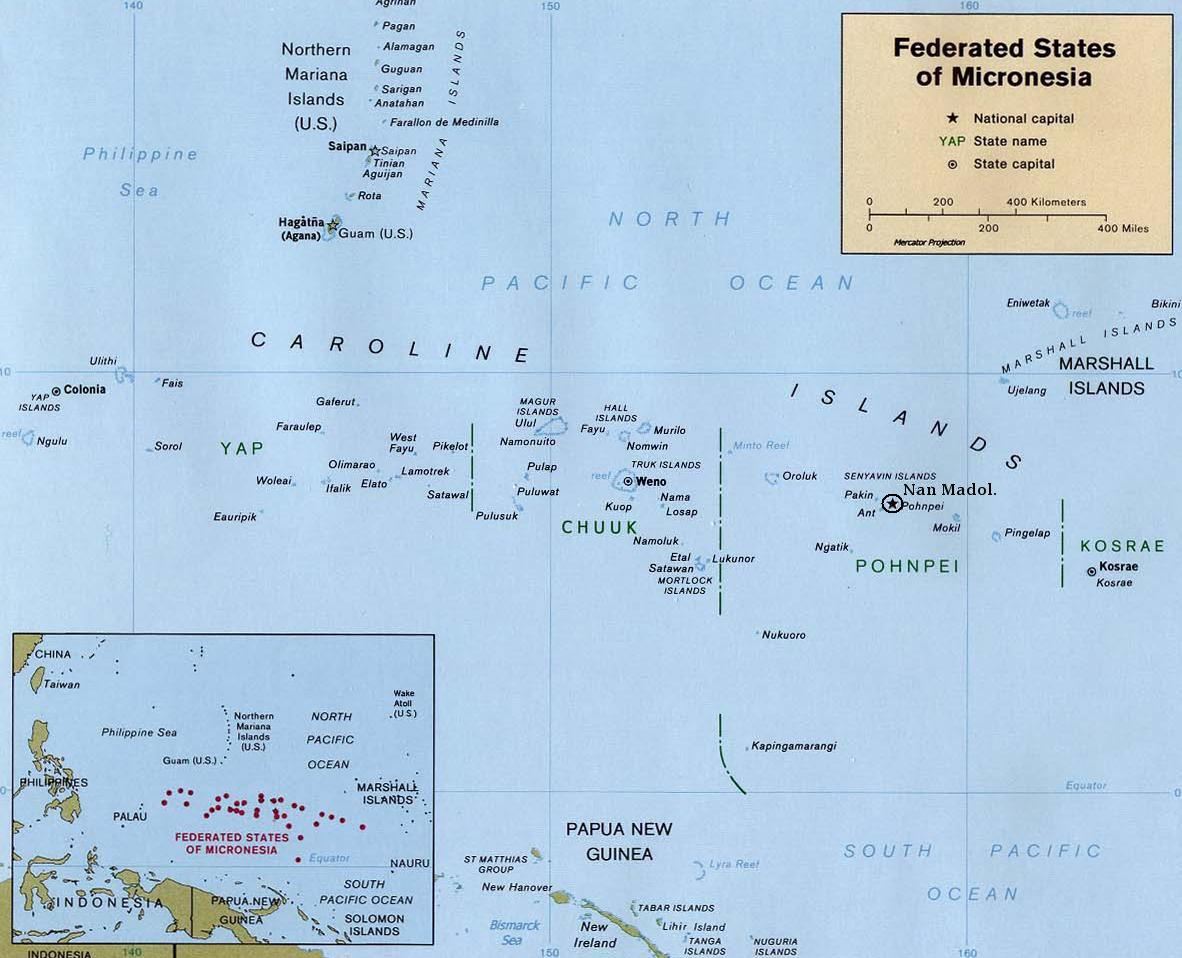
Pohnpei, Micronesia, Pacific Ocean. |
Grid Reference:
06'
57�
N, 158' 12�
E. |
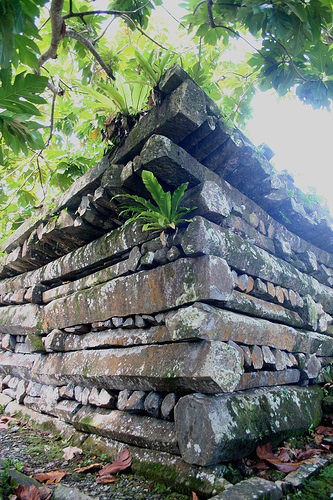
 Nan Modal:
(Island Citadel).
Nan Modal:
(Island Citadel).
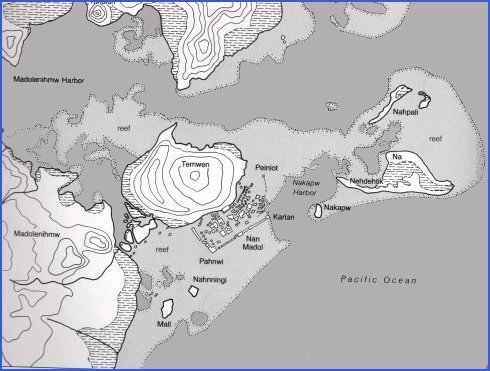
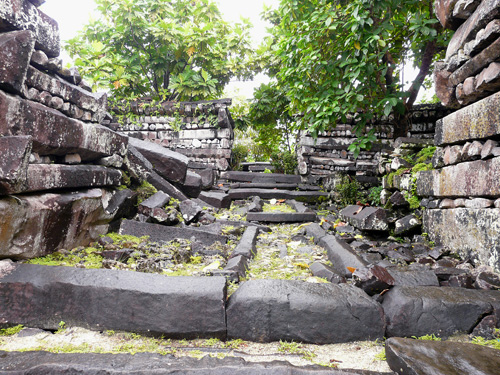
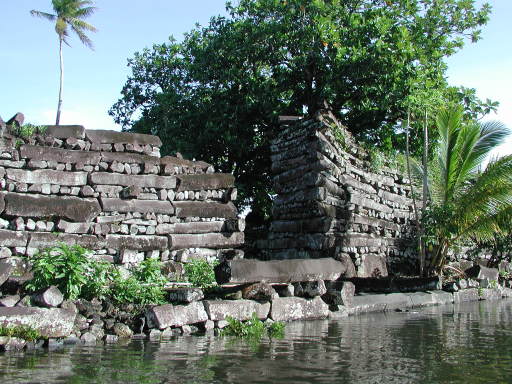
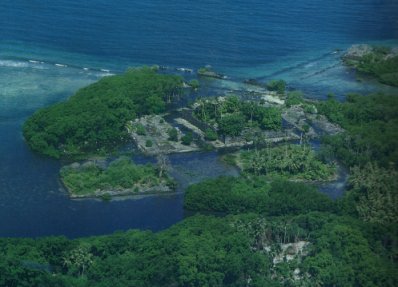
Nan Madol is a ruined city that lies off the eastern shore of
the island of Pohnpei
(presently one of the four states in the
Federated States of Micronesia) and used to be the capital of the
Saudeleur dynasty until about AD 1500.
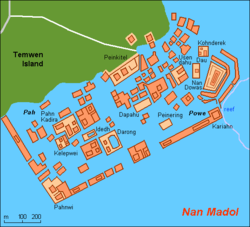
The city consists of over 90 small
artificial islands linked by a network of canals and is often called
the Venice of the Pacific. The name Nan Madol means
"spaces between" and is a reference to the canals that criss-cross the
ruins.
On Nan Madol there is no
fresh water and no food. One must go inland to gather water and grow
food.
Excavations designed to reveal architectural building
stages and style changes verify more than 2000 years of occupation and
possibly a 1000 year span of major construction activity from A.D. 500
to 1500.
(Map with Location)
 Nan
Madol was the ceremonial and political seat of the Saudeleur
dynasty, which united Pohnpei's estimated 25,000 people. Set
apart on the main island of Pohnpei, it was a scene of human
activity as early as the first or second century AD. By the 8th
or 9th century islet construction had started, but the
distinctive megalithic architecture was probably not begun until
perhaps the 12th or early 13th century. Nan
Madol was the ceremonial and political seat of the Saudeleur
dynasty, which united Pohnpei's estimated 25,000 people. Set
apart on the main island of Pohnpei, it was a scene of human
activity as early as the first or second century AD. By the 8th
or 9th century islet construction had started, but the
distinctive megalithic architecture was probably not begun until
perhaps the 12th or early 13th century.
The highly stratified social system at Nan Madol is the
earliest known example of such centralized political power in
the western Pacific. Within the city, social hierarchy was
reflected in the size of the residences built within the
compounds, the largest being the homes of the chiefly elite.
Excavations of these elite residences have revealed the presence
of beads and other ornaments, which may have marked their
owner's social status.
Tradition:
Pohnpeian tradition claims that the builders of
the Lelu complex on Kosrae (likewise composed of huge stone
buildings) migrated to Pohnpei, where they used their skills and
experience to build the even more impressive Nan Madol complex.
However, this is unlikely because radiocarbon dates have placed the
construction of Nan madol prior to that of Lelu. Like Lelu, one
major purpose of constructing a separate city was to insulate the
nobility from the common people.
A local story holds that when Nan Madol was being
built a powerful magician living in the well inhabited region on the
northwest of the island was solicited, and that his help was a major
factor in completing the building. In particular, he was responsible
for supplying the huge stone "logs" used in much of Nan Madol by
"flying" them from their source to the construction site.
An intriguing aspect of Nan Madol is the close
correlation between the oral history of the site and evidence
unearthed during archaeological excavations. For example, oral
traditions make references to small canals cut into the islets,
allowing sacred eels to enter from the sea so that they could be
honoured through the sacrifice of captured sea turtles. Subsequent
excavations have revealed traces of both the small canals and the
sacrificial turtles.
Native Taiwanese populations carry
the purest form of Asian specific Human Lymphocyte Antigens
(A24-Cw8-B48, A24-Cw9-B61 and A24-Cw10-B60) . Studies have
showed that the Taiwan area was the centre of dispersal for the;
Tibetans, Thais, Tlingit, Kwakuitl, Haida, Hawaiian, Maori,
Pima, Maya, Yakut, Inuit, Buryat, Man, Japanese from Shizuoka
and Orochon from North East China. (1) This major
dispersal event, which happened about 6,000 years ago, suggests
a major catastrophic event, such as flooding of the coastline,
which caused an exodus of people, from which many new
civilizations were born. Mysterious megalithic monuments on
Taiwan and numerous underwater ruins north of Taiwan such as
near Yonaguni confirm that a significantly organized society
once existed in this area as much as 10,000 years ago and was
destroyed by rapidly rising sea levels. Interestingly, a flood
is mentioned in the following Hawaiian legend, where it mentions
a great flood on a continent, which resulted in a drift voyage,
and their arrival in Alaska.
'The ancestors of the Hawaiian race came not from the
islands the South Pacific � for the immigrants from that
direction were late arrivals there. � but from the
northern direction (welau lani), that is, from the land
of Kalonakikeke, now known as Alaska.
According to this tradition, a great flood that occurred
during the reign of Kahiko-Luamea on the continent of
Ka-Houpo-o-Kane, (Ta'pen Keng is the ancient name for
Taiwan) and carried away a floating log of wood named
Konikonihia. On this log was a precious human cargo and
it came to rest on the land of Kalonakikeke (Alaska).
On
this log was the first man and woman who came to
Kalonakikeke from the continent of Ka-Houpo-o-Kane, they
were Kalonakiko-ke ("Mr Alaska") and his wife
Hoomoe-a-pule ("Woman of my dreams"). They were said to
both be high chiefs of the countries of Kanaka-Hikina
(person of the east) and Kanaka-Komohana (person of the
west) and were descended from the great great ancestor
Huka-ohialaka.
�Many generations later, Chief Nuu, travelled with his
wife, Lilinoe, their three sons and their three wives in
a canoe called Ka-Waa-Halau-Alii-O-Ka-Moku (the royal
canoe of the continent), and it rested apon Mauna Kea
(white mountain), on the island of Hawaii. They were the
first Hawaiians'.
From �The Ancient
Hawaiian History of Hookumu Ka Lani & Hookumu Ka Honua',
by Solomon L.K. Peleioholani.
Columnar basalt:
The origin of
the rock is no mystery, there are basalt quarries on the mainland which
are identified as being the most likely source for the stone.
Other similar natural formations are found at other locations around the
world:
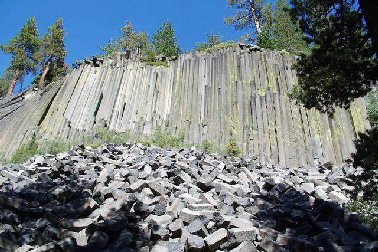
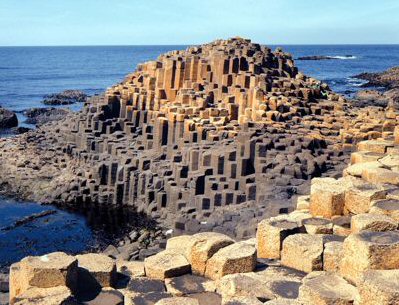
The 'Devils
post-piles', USA (left) and The 'Giants Causeway', Ireland (right)
(More
about the Prehistoric Pacific)
(Other
Underwater Sites)
|